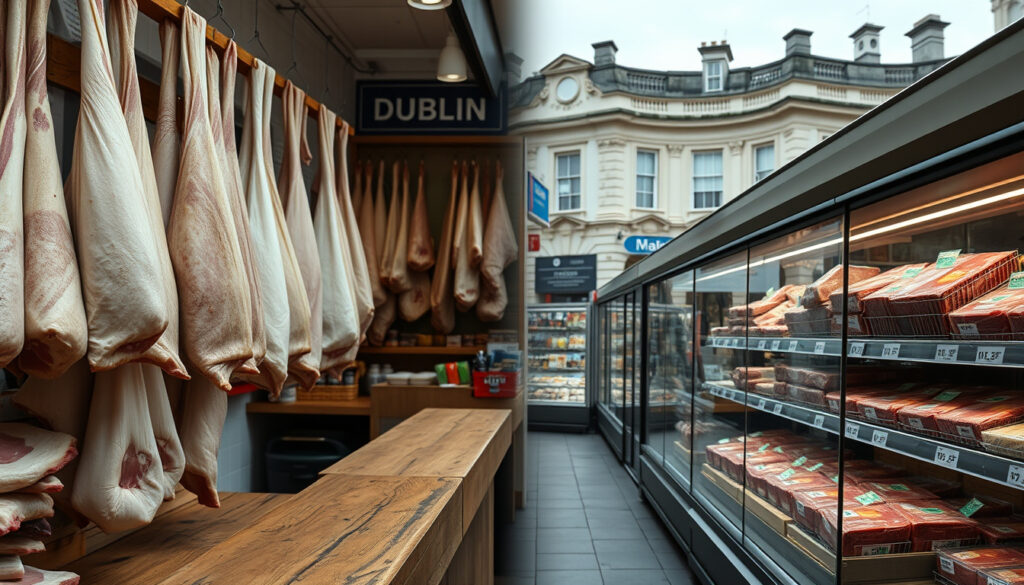
Butcher Shop Near Me: Butcher vs Supermarket Guide (Dublin)
There’s something reassuring about walking into a butcher shop where the counter is busy and the staff knows their cuts. If you’re searching for a butcher shop near me in Dublin, you’re probably weighing up more than just convenience — you want quality you can trust. This guide compares local butchers with supermarkets on freshness, price, and traceability, so you can make a confident choice next time you’re shopping for meat.
Years of experience from leading Dublin butcher: 70+ years (Joe The Butcher) ·
Most consumed meat in Ireland: Chicken, approx. 30 kg per capita annually ·
Irish beef production standard: Grass-fed on local Irish farms (Butcher.ie) ·
Online craft butchers offering nationwide delivery: Kerrigans Butchers delivers across Ireland
Quick snapshot
- Gleesons has over 70 years of butchery experience (Joe The Butcher)
- Irish beef is typically grass-fed on local farms (Butcher.ie)
- Exact price difference between butcher and supermarket in Dublin varies by cut and season
- Current butcher salary in Ireland – no official 2026 data available
- Kerrigans Butchers nationwide delivery claim not independently verified
- Dublin butchers are increasingly promoting traceability to differentiate from supermarket supply chains (Lovin Dublin)
- More butchers will offer online ordering and nationwide delivery, following the model of Kerrigans Butchers
Here’s a quick look at key Dublin meat-sourcing facts.
| Fact | Details |
|---|---|
| Traditional Dublin butcher with longest history | Gleesons Fresh Foods – established over 70 years |
| Irish beef farming standard | Grass-fed, predominantly from local farms |
| Most popular meat in Ireland | Chicken – highest per capita consumption |
| Supermarket meat origin (Lidl UK) | 100% fresh meat from British farms (as per campaign) |
Dublin shoppers face a real trade-off: supermarket prices are hard to beat, but local butchers offer provenance you can verify. The choice isn’t just about cost — it’s about how much you value knowing where your meat came from.
Is buying from a butcher better than a grocery store?
Meat quality and freshness differences
- Butchers source from local farms and often cut meat to order, which can mean better freshness. Joe The Butcher (Dublin craft butcher) says it sources all beef from Hereford and Aberdeen Angus herds raised by local farmers in Wicklow.
- Supermarkets rely on centralised supply chains; pre-packaged meat can lose freshness faster. However, the Food Safety Authority of Ireland (FSAI) mandates that origin labelling for fresh pork, lamb, goat and poultry must be clear, so you can still check.
Price comparison: butcher vs supermarket
- Supermarkets generally have lower base prices on standard cuts due to volume purchasing. But butchers can be competitive on bulk buys, family packs, or off-cuts like chuck eye steak (a “poor man’s ribeye”).
- A 2019 Supermarket News (industry trade publication) report noted Tesco Ireland used DNA tracking to assure customers of Irish beef origin — a sign that supermarkets are investing in credibility.
How to decide based on your needs
If you want a custom cut, cooking advice, and full traceability, a local butcher is the clear choice. If you need convenience and low price on everyday staples, the supermarket wins. The Lovin Dublin guide to the best butchers says a reputable butcher can tell you exactly which farm the meat came from and how it was reared — a level of transparency supermarkets rarely match.
The implication: matching your shopping habits to the right source saves both money and disappointment.
Is meat cheaper at a butcher or supermarket?
Price differences on standard cuts
- For chicken breast or minced beef, supermarkets typically beat butchers on price. But butchers often price specialty cuts (dry-aged steaks, Irish grass-fed lamb) competitively when compared to premium supermarket lines.
- Eurasia Butcher (Dublin halal butcher) offers top-quality meat with complete traceability, and their prices reflect the farm-to-counter model.
Bulk buying and value
- Buying a half-pig or a whole lamb direct from a butcher can yield significant savings per kilo. Butcher.ie prides itself on paying fair prices to farmers and passing on value through environmentally friendly packaging.
- Supermarket “family packs” are convenient but often more expensive per kilo than a butcher’s bulk order.
Hidden costs of each
- Supermarket meat may include packaging that can’t be recycled easily. Butcher shops often use paper wrapping and allow you to bring your own container.
- The time cost of going to a specialist butcher and planning ahead is offset by better eating quality — a trade-off many Dublin families accept.
The pattern: splitting purchases gives you the best of both worlds.
Dublin buyers who split their meat purchases between a local butcher and a supermarket can optimise both budget and taste. The butcher for Sunday roasts and steaks; the supermarket for weekday mince and chicken.
Where do Dunnes and Lidl get their meat from?
Dunnes Stores meat sourcing practices
- Dunnes operates quality assurance schemes that source Irish beef from Bord Bia–approved farms. While the retailer does not publicly list every supplier, it strongly emphasises Irish origin on its packaging.
- Business Companion (UK trading standards guidance) states that supplementary provenance claims must not mislead consumers — a rule that applies to all retailers.
Lidl’s ‘Backing British Farming’ campaign
- In the UK, Lidl claims 100% of its fresh meat comes from British farms. In Ireland, Lidl sources pork, chicken, and beef from Irish suppliers where available, though specific country-of-origin data is not always on the label.
- The FSAI notes that if meat does not originate in a single EU country, the business must indicate origin of the primary ingredient (e.g., “EU” or “non-EU”).
How supermarket sourcing compares to local butchers
- Butchers like The Dublin Butcher state they source close to home whenever possible, but also supplement with Australian produce — a reminder that even local butchers sometimes import.
- Supermarket supply chains prioritise cost efficiency, which can mean sourcing from multiple countries. Butchers who own their supply (e.g., Brady’s Butcher, which uses its own farm in Meath) offer the ultimate traceability.
The implication: Dublin shoppers who want guaranteed Irish origin are better off at a butcher than a supermarket, because they can ask the counter directly and get an immediate answer.
What is the going rate for a butcher?
Average salary for butchers in Dublin and London
- Butcher salaries in London are projected to range from £20,000 to £30,000 by 2026. Dublin rates are similar, though cost-of-living adjustments push experienced butchers higher.
- Factors like years of experience, specialisation (e.g., dry-aging), and location (city versus rural) affect wages. Demand for skilled butchers remains steady as craft butchery sees a revival.
Factors affecting butcher wages
- Training through apprenticeships or meat industry qualifications can boost earning potential.
- Butchers who work at premium shops (like FX Buckley, which has two Dublin locations) may earn more due to higher-end clientele.
Butcher career outlook
- The craft butchery movement and consumer demand for local, traceable meat are driving a slow but steady rise in openings. New butchers are opening in Dublin suburbs, and many offer online ordering to reach more customers.
What’s the unhealthiest meat to eat?
Red and processed meats: health risks
- The World Health Organization classifies processed meats (bacon, sausages, ham) as Group 1 carcinogens, meaning there is strong evidence they cause cancer. Red meat is classified as Group 2A (probably carcinogenic).
- High saturated fat content in red meat can raise LDL cholesterol, increasing heart disease risk.
Comparison of poultry, fish, and red meat
- Lean poultry (chicken breast without skin) and fish are healthier choices. Chicken is the most consumed meat in Ireland, with per capita consumption around 30 kg annually.
- Fatty fish (salmon, mackerel) provide omega-3 fatty acids that support heart health.
Tips for choosing healthier meat options
- Choose lean cuts: sirloin, fillet, or chicken breast.
- Limit processed meats to occasional treats.
- Grass-fed Irish beef from local butchers often has a better fat profile than grain-fed alternatives.
The takeaway: lean choices and moderation matter more than the source.
What is poor man’s meat called?
Origin of the term ‘poor man’s meat’
- Historically, “poor man’s meat” referred to legumes (beans, lentils) or offal (liver, kidneys) because they were cheap protein sources for low-income families.
- The term also applies to inexpensive cuts of meat that deliver flavour similar to premium cuts — like the chuck eye steak, known as “poor man’s ribeye.”
Examples: beans, lentils, offal
- Beans and lentils are still among the most cost-effective protein sources in Ireland. Offal, such as liver and heart, is rich in nutrients and often available at butchers for a fraction of the price of fillet.
What is a poor man’s ribeye?
- The poor man’s ribeye is the chuck eye steak, cut from the shoulder of the cow. It has similar marbling and flavour to ribeye but costs significantly less. Many Dublin butchers offer it as a house recommendation.
The pattern: What was once a budget necessity is now rediscovered by foodies. For Dublin shoppers, asking your butcher for “chuck eye steak” can get you restaurant-quality beef at half the price.
“Poor man’s” cuts require proper cooking — chuck eye can be tough if not cooked low and slow. Your butcher can advise on the best method, something a supermarket package never offers.
Butcher vs supermarket: a side-by-side comparison
Four dimensions, one clear pattern: butchers dominate on transparency and quality; supermarkets on price and convenience.
| Factor | Local butcher | Supermarket |
|---|---|---|
| Source transparency | Knows the farm directly; can name the farmer (Lovin Dublin) | Relies on label; origin may be “EU” or multiple countries (FSAI) |
| Meat quality | Often grass-fed, dry-aged, custom cuts (Butcher.ie) | Typically grain-finished, pre-packaged |
| Price for standard cuts | Higher per kg on average | Lower per kg, frequent promotions |
| Price for bulk/specialty | Competitive; can save on whole animals | Rarely offers bulk discounts |
| Service | Personal advice, custom cuts, cooking tips | Self-service, limited interaction |
| Convenience | Fewer locations, limited hours | Many locations, extended hours |
What this means: The choice is not binary. Many Dublin households buy staples at the supermarket and splurge on special cuts at the butcher.
Pros and Cons of butcher vs supermarket
Upsides
- Butcher: superior traceability and quality
- Butcher: custom cuts and personal advice
- Supermarket: lower prices and wider availability
- Supermarket: consistent inventory and longer hours
Downsides
- Butcher: higher prices on standard cuts
- Butcher: limited locations and hours
- Supermarket: less traceability, pre-packaged meat
- Supermarket: no custom cuts or cooking guidance
How to find a good butcher shop near me in Dublin
- Search online — Use “butcher shop near me Dublin” and check Google Maps reviews. Look for shops with high ratings and recent photos of fresh counter displays.
- Ask about sourcing — A good butcher can tell you the farm name and rearing method. Lovin Dublin’s guide recommends confirming traceability directly.
- Check for certifications — Look for Bord Bia quality assurance logos or evidence of grass-fed beef.
- Visit the counter — Observe cleanliness, the range of cuts, and whether staff offer advice. Butchers like Brady’s (four Dublin locations) are known for family tradition and personal service.
- Try online delivery — If no good butcher is nearby, services like Kerrigans Butchers deliver nationwide. Butcher.ie also offers pre-selected boxes.
The proof: a butcher who names the farmer earns your trust.
What we know and what remains unclear
Confirmed facts
- Gleesons Fresh Foods has over 70 years of butchery experience (Joe The Butcher)
- Butcher.ie selects only the finest cuts of prime Irish beef, grass-fed on local farms (Butcher.ie)
- Brady’s Butcher sources its own meat from its farm in Meath (Lovin Dublin)
What is unclear / rumour
- Exact price difference between butcher and supermarket in Dublin varies by cut and season
- Current butcher salary in Ireland – no official 2026 data available
- Some butchers (e.g., The Dublin Butcher) supplement Irish supply with Australian produce, but the proportion is not publicly verified
- Kerrigans Butchers nationwide delivery claim not independently verified
Quotes from Dublin butchers
“With over 70 years butchers experience in the farming and meat industry, we supply quality and service to the highest standards possible.” For those seeking storage solutions, IKEA wardrobes for small Dublin rooms can offer inspiration.
— Joe The Butcher, Dublin craft butcher
“The highest quality Irish beef. Grass-fed on local Irish farms. We select only the finest cuts of prime beef.”
— Butcher.ie, online butchery
For Dublin shoppers, the choice between a local butcher and a supermarket is not about one being “better” in every way. It’s about matching your shopping habits to the right source. If you value knowing that your Sunday roast came from a farm in Meath, the butcher is the only option. If you need chicken breasts on a Tuesday evening, the supermarket works fine. The smartest move? Get to know a good butcher for the special meals, and stock up on staples at the supermarket. That way, you get the best of both worlds: traceability when it matters, and convenience the rest of the time. For Dublin families, the implication is clear: build a relationship with a local butcher, and you’ll never wonder where your meat came from again.
pid-labelling.co.uk, instagram.com, facebook.com, facebook.com, instagram.com
For those seeking a broader perspective beyond Dublin, the guide to local and online butchers in Ireland offers additional insights into sourcing quality meat across the country.
Frequently asked questions
How do I find a butcher shop near me that is open now?
Search Google Maps for “butcher shop near me” and filter by “open now.” In Dublin, many butchers operate 9am–6pm Monday to Saturday; some open on Sunday for morning hours. For guaranteed access, check individual shop websites or call ahead.
What are the best butcher shops in Dublin?
Top-rated include Gleesons Fresh Foods, Brady’s Butcher (four locations: Belvedere, Fairview, Templeogue, Newcastle), FX Buckley (Talbot Street and Nutgrove), Joe The Butcher, and The Dublin Butcher. Lovin Dublin provides a curated list.
Do butcher shops deliver meat to my home?
Yes. Kerrigans Butchers and Butcher.ie deliver nationwide. Many local butchers also offer delivery within Dublin. Check their website or call to confirm coverage.
Is it cheaper to buy meat in bulk from a butcher?
Usually yes. Half-pigs or whole lambs from a butcher can cost significantly less per kilo than individual cuts. Supermarket bulk packs are often more expensive per kilo and less customisable.
What cuts of meat are considered ‘poor man’s ribeye’?
The chuck eye steak, taken from the shoulder of the cow, is known as “poor man’s ribeye” for its similar marbling and flavour at half the price. Ask your butcher for it — many Dublin butchers keep it behind the counter.
How can I tell if meat is fresh at a butcher?
Look for bright red colour (beef), no off-odours, and a clean counter. The meat should be displayed at proper refrigeration temperature. A reputable butcher will allow you to smell and touch (through the wrapper) before buying.
Are there any halal butcher shops near me in Dublin?
Yes. Eurasia Butcher (Dublin) sources halal meat with full traceability. Many other halal butchers operate along the South Circular Road and in Blanchardstown. Use Google Maps with the query “halal butcher Dublin” for the most up-to-date list.
More related posts
 Julia Haart Net Worth: Her $100M Fortune Explained
 Tank vs Ryan Garcia: How catchweight and clause decided the fight
 Microsoft Customer Service Phone Number 24/7: Get Help Now
 You’re Losing Me Lyrics: Taylor Swift’s Saddest Song
 What Does 8647 Mean? Comey Post and Trump Controversy
 Can Dogs Have Cashews? Safety, Quantity & Risks
 Doki Doki Literature Club: Parents’ Guide to 18+ Rating
 Blue Jays vs Red Sox – Final Score, Highlights and Analysis