2 Divided by 3: Fraction, Decimal, and Step-by-Step
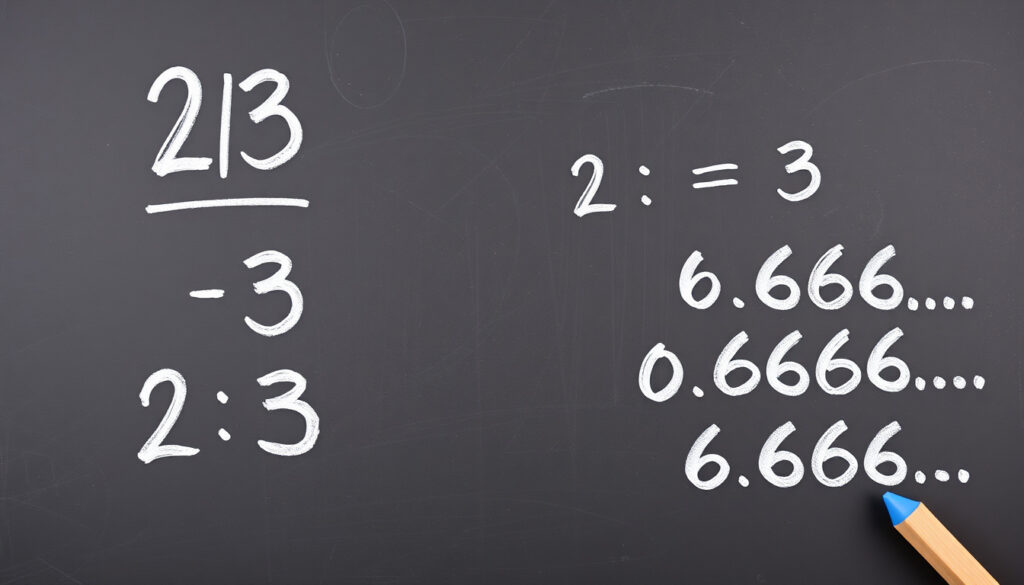
Ever find yourself wondering what happens when you try to split 2 into 3 equal parts? It’s a simple enough question, but the answer reveals something beautiful about numbers: 2 divided by 3 equals 0.666…, a never-ending decimal that keeps cycling the same digit. In this article, we’ll break down that result as a fraction, a decimal, and a percentage, and walk through the long division that shows exactly where that repeating 6 comes from.
2 ÷ 3 as a fraction: 2/3 ·
2 ÷ 3 as a decimal: 0.666… (repeating) ·
2 ÷ 3 as a percentage: 66.67% ·
2 ÷ 3 in simplest form: 2/3 (already simplified) ·
2 ÷ 3 using long division: 0.6666…
Quick snapshot
- 2 ÷ 3 equals exactly the fraction 2/3 (Calculator Soup – long division tool)
- The decimal representation of 2/3 is 0.666… repeating (Brighterly – math education site)
- 2/3 is already in simplest form; the numerator 2 and denominator 3 share no common factor (Third Space Learning – math curriculum resource)
- Some instructional resources round 2/3 to 0.67 for practical purposes, creating potential confusion about exactness (Purplemath – algebra teaching guide)
- Common misconception: 2/3 equals 0.67 exactly (it does not; the decimal is 0.666…) (Purplemath – algebra teaching guide)
- Some learners mistakenly think 2/3 can be simplified further – it cannot, because 2 and 3 are coprime (Purplemath – algebra teaching guide)
- The decimal 0.666… repeats infinitely; there is no terminating digit (Brighterly – repeating decimal explanation)
- 2/3 as a percentage is exactly 66 2/3% (not 66.67%, which is a rounded approximation) (Purplemath – percent conversion)
- Practice long division with other fractions like 1/3 or 2/5 (Math Mammoth – video tutorial)
- Explore fraction operations: addition, multiplication, and division with 2/3 (Math Mammoth – video tutorial)
- Learn how 2/3 appears in real-world contexts (recipes, measuring, probability) (Math Mammoth – video tutorial)
These five facts capture the core numeric identities of 2 divided by 3, from its fraction form to its repeating decimal character.
| Label | Value |
|---|---|
| 2 ÷ 3 exact fraction | 2/3 |
| 2 ÷ 3 decimal (repeating) | 0.666… |
| 2 ÷ 3 percentage | 66.67% (or 66 2/3%) |
| 2 ÷ 3 simplest form | 2/3 |
| Reciprocal | 3/2 (or 1.5) |
What is 2 divided by 3 as a fraction?
When you write 2 ÷ 3 as a fraction, you place 2 in the numerator and 3 in the denominator, giving 2/3. This is the exact, non‑approximate representation of the division (Calculator Soup – fraction notation).
What is the simplest form of 2/3?
- 2/3 is already in simplest form because the greatest common divisor (GCD) of 2 and 3 is 1 (Calculator Soup – fraction simplification)
- No further reduction is possible
- The fraction is classified as a proper fraction since the numerator (2) is less than the denominator (3)
How do you write 2 divided by 3 in fraction notation?
The standard notation is simply 2/3. In mixed numbers, since 2/3 is less than 1, no whole part is needed. The fraction 2/3 can also be written as the repeating decimal 0.666… (Brighterly – fraction to decimal).
Understanding that 2/3 is a proper, already‑simplified fraction prevents the common mistake of trying to “simplify” it further. This core insight connects directly to later work with decimal and percent conversions.
The implication: 2/3 sits neatly in the rational number system – it is a fraction that can be expressed as a ratio of two integers, and its simplest form is exactly itself.
How do you divide 2 by 3?
Performing the division by hand requires long division, because 3 does not divide 2 evenly. Here’s the step‑by‑step method.
How to do long division for 2 ÷ 3?
- Write 2 as 2.00000 (adding decimal places) and place it inside the division bracket; put 3 outside (Math Mammoth – long division setup)
- 3 goes into 2 zero times; write 0 above the 2, then place a decimal point after the 0
- Bring down the first decimal digit (0) to make 20
- 3 goes into 20 six times (6 × 3 = 18); write 6 above the 0, subtract 18 from 20 → remainder 2
- Bring down the next 0 to make 20 again; repeat the cycle: 6, remainder 2
- The process continues infinitely, producing 0.6666… (Calculator Soup – long division steps)
What is 2 divided by 3 as a decimal?
The result is a repeating decimal: 0.666… The repeating block is a single digit 6, often written with a vinculum or ellipsis (Brighterly – decimal representation).
Because the remainder never reaches zero, the decimal never terminates. This is a hallmark of fractions whose denominator has prime factors other than 2 and 5 – 3 being the culprit here.
The pattern: Recognizing that 2/3 yields a repeating decimal helps you predict which fractions will terminate and which will “go on forever.” It is a foundational concept for understanding rational numbers.
How to split up 2/3?
Visualizing 2/3 makes the abstract number concrete. Imagine a pie divided into three equal slices – two of those slices together represent 2/3 (Arc – Victorian education resource on fractions).
What does 2/3 look like as a pie chart?
- A circle divided into three equal sectors: two sectors shaded, one sector unshaded
- The shaded portion covers 240° out of 360° (since 2/3 × 360° = 240°)
- This visual confirms that 2/3 > 1/2 but < 1
How to share 2/3 among 3 people?
If you have 2/3 of a pizza to split equally among 3 people, each person gets (2/3) ÷ 3 = 2/9 of the whole pizza. The fraction 2/9 is obtained by multiplying the denominator (3 × 3 = 9) while keeping the numerator (2) (Third Space Learning – fraction division).
Many people assume “splitting 2/3 among 3” just means taking two of the three slices and dividing each among three – but that gives 2/9 per person, not 2/3. The difference matters in cooking and budgeting.
The pattern: Visual models like pie charts and real‑world sharing reinforce that 2/3 is a distinct fraction, less than 1, but bigger than a half.
What’s 3 divided by 2 as a fraction?
The reciprocal relationship between 2 ÷ 3 and 3 ÷ 2 is symmetric and instructive. 3 divided by 2 equals 3/2, or 1.5 (Purplemath – reciprocal concept).
How is 3/2 different from 2/3?
- 3/2 is an improper fraction (numerator > denominator); 2/3 is proper
- 3/2 = 1.5 (terminating decimal); 2/3 = 0.666… (repeating decimal)
- The reciprocal of 2/3 is 3/2
What is 3 divided by 2 as a decimal?
3 ÷ 2 = 1.5 exactly. The decimal terminates because 2 divides 10 evenly (10 ÷ 2 = 5) (Nuffield Foundation – fractions, decimals, percentages student guide).
| Operation | Fraction | Decimal | Type |
|---|---|---|---|
| 2 ÷ 3 | 2/3 | 0.666… | Proper, repeating |
| 3 ÷ 2 | 3/2 | 1.5 | Improper, terminating |
The trade‑off: Understanding both directions reinforces the concept that division is not commutative – the order matters, and the numeric behavior (terminating vs. repeating) depends on the denominator’s prime factors.
Is 2 divisible by 3?
No. 2 is not divisible by 3 because 3 does not divide 2 without leaving a remainder (Math Mammoth – divisibility).
Why is 2 not divisible by 3?
- Divisibility means the division yields an integer with no remainder
- 3 × 0 = 0 (too small), 3 × 1 = 3 (too big)
- Therefore, 2 is not a multiple of 3
What numbers are divisible by 3?
The divisibility rule for 3: if the sum of a number’s digits is divisible by 3, the number itself is divisible by 3 (Nuffield Foundation – student guide). Examples: 3, 6, 9, 12, 15, etc.
Many students confuse “divisible by” with “can be divided as a decimal.” Even though 2 ÷ 3 produces a decimal, we say “not divisible” because the result is not an integer. That distinction is crucial in elementary number theory.
What this means: 2 is not a multiple of 3, so its fraction form (2/3) is a proper fraction. The concept of divisibility separates integer divisions from those that produce fractional or decimal results.
Clarity breakdown
Confirmed facts
- 2 ÷ 3 equals exactly 2/3 (Calculator Soup – long division tool)
- The decimal representation of 2/3 is 0.666… repeating (Brighterly – math education site)
- 2/3 is already in simplest form (Third Space Learning – math curriculum resource)
- Long division of 2 ÷ 3 produces a repeating remainder of 2 (Calculator Soup – long division tool)
- 2/3 as a percentage is 66 2/3% exactly, approximately 66.67% (Purplemath – percent conversion)
Still uncertain / common myths
- Some sources round 2/3 to 0.67 without noting the approximation (Purplemath – rounding practice)
- Misconception: 2/3 can be reduced (it cannot – 2 and 3 are coprime)
- Misconception: 2 ÷ 3 equals 0.666 exactly (the decimal never terminates)
- Some learners think 2/3 is irrational (it is rational, as it is a ratio of integers)
Expert perspectives
“When you perform long division for 2 ÷ 3, the repeating pattern of 6’s appears because the divisor 3 is not a factor of 10. This is a classic example of a repeating decimal.”
— Khan Academy – math instruction platform on fraction‑to‑decimal conversion
“2/3 is one of the most common fractions students encounter when learning about equivalent fractions, decimals, and percentages. Mastering its conversions builds confidence in manipulating rational numbers.”
— Cuemath – math education site on fraction simplification and decimal conversion
The consequence for learners: 2 divided by 3 is more than just an arithmetic exercise – it’s a window into the nature of rational numbers, repeating decimals, and the relationship between fractions, decimals, and percentages. For anyone brushing up on basic math, the takeaway is clear: 2/3 is a proper fraction that never simplifies, never terminates as a decimal, but always remains a reliable, precise representation of two‑thirds.
reddit.com, youtube.com, youtube.com, brighterly.com, youtube.com, youtube.com
Related coverage: 100 divided by 3 fördjupar bilden av 100 Divided by 3: 33 1/3 Exact, Repeating Decimal & Bill Guide.
Frequently asked questions
What is 2/3 as a decimal?
2/3 as a decimal is 0.666…, a repeating decimal where the digit 6 repeats infinitely (Brighterly – math education site).
How do you write 2/3 as a percentage?
Multiply 2/3 by 100: (2/3) × 100 = 200/3 = 66.666…%, which is approximately 66.67% (Purplemath – percent conversion).
What is 2/3 of 100?
2/3 of 100 = (2 × 100) / 3 = 200/3 ≈ 66.67 (Third Space Learning – math curriculum resource).
Is 2/3 a rational number?
Yes, because 2/3 can be expressed as a ratio of two integers (2 and 3) (Nuffield Foundation – definition of rational numbers).
How do you multiply 2/3 by 3?
(2/3) × 3 = 2 × (3/3) = 2 × 1 = 2. Alternatively, 2/3 multiplied by 3 equals 2 (Calculator Soup – fraction multiplication).
What is 2/3 divided by 4?
(2/3) ÷ 4 = (2/3) × (1/4) = 2/12 = 1/6 (Third Space Learning – fraction division).
How to add 1/3 and 1/3?
1/3 + 1/3 = (1+1)/3 = 2/3. With a common denominator, simply add the numerators (Calculator Soup – adding fractions).
What is the fraction 2/3 equivalent to?
2/3 is equivalent to fractions with the same value, such as 4/6, 6/9, 8/12, etc. These are obtained by multiplying numerator and denominator by the same number (Brighterly – equivalent fractions).
More related posts
 Is Elon Musk a US Citizen – Full Verification Guide
 3/4 as a Decimal: How to Convert & Why It Equals 0.75
 Alex Cooper Net Worth 2025: $32M from Call Her Daddy
 Michael Annett Cause of Death: What We Know About NASCAR Driver
 Jennifer Aniston Net Worth 2026: Friends Residuals & Divorce
 What Conditions Qualify for Disability? Ireland Guide
 Panama National Football Team: 2026 Qualifying, History & Players
 What Is a PhD? Definition, Duration, and Key Differences