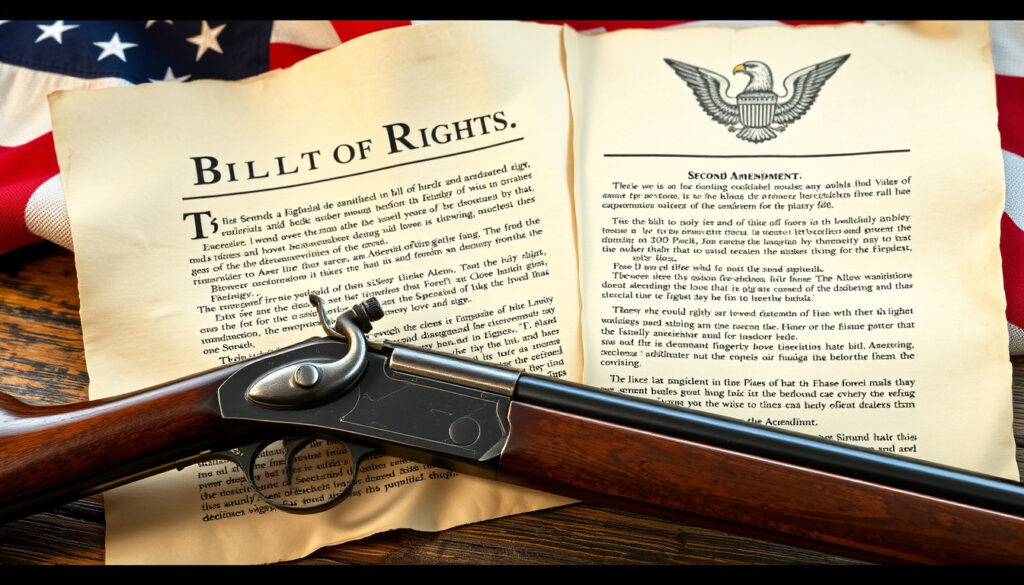
Right to Bear Arms: 2nd Amendment History, Text & Meaning
Few constitutional provisions have sparked as much courtroom drama as the Second Amendment. Ratified on December 15, 1791, these 27 words have sustained decades of Supreme Court cases and remain a flashpoint in American civic life.
Ratified: December 15, 1791 · Part of: Bill of Rights · Applies to: United States · Word count: 27 · Key clause: shall not be infringed
Quick snapshot
- 27-word text from the Constitution (Wikipedia)
- Ratified December 15, 1791 (Wikipedia)
- Part of the first 10 amendments (Bill of Rights) (Cornell Law)
- Precise modern scope without court rulings (Harvard Journal of Law & Public Policy)
- How future legislation interacts with historical tradition test (Harvard Journal of Law & Public Policy)
- English Bill of Rights (1689) → Founding era → 2022 Bruen ruling (Cornell Law)
- Historical tradition now the primary interpretive lens (Cornell Law)
- Lower courts applying Bruen’s text-history-tradition test to new regulations (Harvard Journal of Law & Public Policy)
- Ongoing legislative activity at state and federal levels (Harvard Journal of Law & Public Policy)
This key facts table captures the constitutional lineage and major legal milestones for the Second Amendment.
| Fact | Detail |
|---|---|
| Official Text Source | constitution.congress.gov |
| Ratification Year | 1791 |
| Proposing Congress | 1789 |
| Total Amendments | 27 |
| Precedent Source | English Bill of Rights (1689) |
| First Supreme Court Ruling | United States v. Cruikshank (1876) |
What is the US 2nd Amendment?
The Second Amendment to the United States Constitution reads: “A well regulated Militia, being necessary to the security of a free State, the right of the people to keep and bear Arms, shall not be infringed.” These 27 words have been endlessly debated by legal scholars, judges and justices in the modern age, yet their core protection has remained consistent since ratification.
Text of the amendment
The enrolled original Joint Resolution passed by Congress on September 25, 1789, reads: “A well regulated militia, being necessary to the security of a free State, the right of the People to keep and bear arms, shall not be infringed.” James Madison drafted an initial version that included a conscience clause exempting religiously scrupulous persons from military service, but this provision did not survive into the final text.
The final language was agreed to and transmitted to the states in late September of 1789, marking the culmination of a drafting process that began with Madison’s initial proposal and was refined through House and Senate deliberation.
Historical context
Historical surveys of the Second Amendment trace its roots through the English Bill of Rights of 1689, which declared that “subjects, which are protestants, may have arms for their defence suitable to their condition, and as allowed by law.” That English provision grew out of friction over the Crown’s efforts to use loyal militias to control and disarm dissidents prior to the Glorious Revolution.
What exactly is the right to bear arms?
The right to bear arms refers to the constitutional protection for individuals to possess weapons. Historical surveys trace this protection through the English Bill of Rights of 1689, which codified the right of English subjects to possess arms for their defense, though that right was limited in scope.
Legal definition
In United States v. Cruikshank (1876), the Supreme Court ruled that “The right to bear arms is not granted by the Constitution; neither is it in any manner dependent upon that instrument for its existence.” This decision reflected the prevailing view at the time that the amendment restricted only federal power. Barron v. City of Baltimore (1833) had established that the Bill of Rights applies only to the Federal Government, not to the states.
On multiple occasions in the late 19th century, the Supreme Court affirmed that the Second Amendment “is a limitation only upon the power of Congress and the national government, and not upon that of the state.” The incorporation of the Second Amendment against the states through the Fourteenth Amendment would not occur until the 20th century.
Scope of protection
The Supreme Court has made clear that individual rights enumerated in the Bill of Rights and made applicable against the States through the Fourteenth Amendment have the same scope as against the Federal Government. In District of Columbia v. Heller (2008), the Court addressed the Second Amendment for the first time in almost 70 years after Dick Heller sued the District of Columbia over its ban on handguns, establishing that the amendment protects an individual’s right to possess firearms for traditionally lawful purposes.
The Supreme Court’s 2008 Heller decision transformed the legal landscape: what had been debated primarily among scholars became settled constitutional doctrine with real-world implications for gun regulations nationwide.
The implication is that any firearm regulation must now demonstrate historical precedent from the Founding era to survive constitutional scrutiny.
What are the first 10 Amendments?
The Bill of Rights consists of the first 10 amendments to the United States Constitution, proposed by Congress in 1789 and ratified by three-fourths of the states on December 15, 1791. James Madison initially opposed a bill of rights prior to ratification but was persuaded to support adding one and promised the electorate he would support it. Madison won his election and went to Congress politically committed to supporting a bill of rights.
Overview of Bill of Rights
The Bill of Rights was ratified by three-fourths of the states on December 15, 1791, having been ratified as a group by all fourteen states then in existence except Connecticut, Massachusetts, and Georgia, which added ratifications in 1939. These amendments secure fundamental liberties including speech, religion, and due process.
Key protections
The amendments protect individual liberties ranging from religious exercise (First Amendment) to protection against unreasonable searches (Fourth Amendment) to the right to keep and bear arms (Second Amendment). Each amendment addresses a specific concern raised during the ratification debates over the proposed Constitution.
What are the 1st, 2nd, and 3rd amendments?
The first three amendments address distinct aspects of liberty and government power. The First Amendment protects speech, religion, and press; the Second Amendment addresses arms bearing; and the Third Amendment concerns the quartering of soldiers.
1st Amendment summary
The First Amendment begins: “Congress shall make no law respecting an establishment of religion, or prohibiting the free exercise thereof; or abridging the freedom of speech, or of the press; or the right of the people peaceably to assemble.” It forms the foundation of American expressive and religious liberty.
3rd Amendment details
The Third Amendment reads: “No Soldier shall, in time of peace be quartered in any house, without the consent of the Owner, nor in time of war, but in a manner to be prescribed by law.” This provision responded directly to British practices during the colonial period and remains part of the constitutional framework, though it has never been the basis for a Supreme Court decision.
Together, the first three amendments reflect a coherent philosophy: limiting government power over individuals’ homes, worship, speech, and self-defense. The framers saw these as interconnected protections against state overreach.
What this means is that constitutional rights around personal autonomy were designed as a bundle, not as isolated protections.
Why is the right to bear arms important?
The right to bear arms holds a foundational position among constitutional protections. During the Fourteenth Amendment debates, Senator Garret Davis stated that the Founders “were for every man bearing his arms about him and keeping them in his house, his castle, for his own defense.” Senator Samuel Pomeroy counted among the “safeguards of liberty” “the right to bear arms for the defense of himself and family and his homestead.”
Foundational to other rights
Rep. George W. Julian argued during the Fourteenth Amendment debates that the amendment was needed because Southern courts declared the Civil Rights Act void and some states made it “a misdemeanor for colored men to carry weapons without a license.” The Freedmen’s Bureau Act explicitly declared that the right to have full and equal benefit of all laws concerning personal liberty, personal security, and the acquisition and enjoyment of estate, “including the constitutional right to bear arms, shall be secured to and enjoyed by all the citizens of such State or district without respect to race or color, or previous condition of slavery.”
Security of free state
In Bruen, the Supreme Court reaffirmed that “Constitutional rights are enshrined with the scope they were understood to have when the people adopted them.” The Court warned against giving “post-enactment history more weight than it can rightly bear” and reaffirmed that post-Civil War discussions of the right to keep and bear arms do not provide as much insight into its original meaning as earlier sources.
Timeline
The timeline below maps the constitutional evolution from English roots through modern Supreme Court rulings.
| Date | Event |
|---|---|
| 1689 | English Bill of Rights establishes right to possess arms |
| June 1789 | Madison introduces draft amendments to Congress |
| August 24, 1789 | House passes version of Second Amendment |
| September 21, 1789 | House accepts Senate changes |
| September 25, 1789 | Final Joint Resolution transmitted to states |
| December 15, 1791 | Bill of Rights ratified |
| 1934 | National Firearms Act passed following FDR assassination attempt |
| 2008 | Heller decision affirms individual right |
| June 2022 | Bruen decision establishes text-history-tradition test |
The pattern across two centuries is consistent: courts look to historical sources to determine what the Second Amendment meant at adoption, and regulatory frameworks must account for that meaning.
Following an attempt on the life of President-elect Franklin D. Roosevelt with a handgun in 1933, Congress passed the National Firearms Act of 1934, the first significant federal gun control legislation. In June 2022, the Supreme Court decided New York State Rifle & Pistol Association, Inc. v. Bruen, its most significant case interpreting the scope of the Second Amendment since Heller. In Bruen, the Supreme Court adopted a “text, history, and tradition” test to determine the Second Amendment’s meaning and scope, rejecting a two-part interest balancing test.
What remains settled and what is still contested
Certain facts about the Second Amendment are beyond dispute. The exact text comes directly from the Constitution, and the ratification date of December 15, 1791, is established historical record. The amendment’s origins in the English Bill of Rights of 1689 are documented across primary sources.
Confirmed facts
- Exact text from Constitution (Congress.gov authoritative text)
- Ratification date December 15, 1791 (Wikipedia historical record)
- 27-word length (New Jersey State Bar Association)
- Rooted in English Bill of Rights (Cornell Law historical analysis)
- Individual right confirmed in Heller (2008) (Giffords Law Center case summary)
What’s unclear
- Precise modern scope without ongoing court rulings
- Application of text-history-tradition test to specific regulations
- How future legislation will be evaluated
The catch is that lower courts now bear the burden of applying the Bruen framework to firearms regulations enacted long after 1791, and the outcomes will determine the practical scope of the right for years to come.
How courts interpret the amendment today
The Founding period, not 1868, is the proper reference point for determining the original public meaning of the Second Amendment. Every Supreme Court case that has examined historical evidence to determine the meaning or scope of the first eight provisions of the Bill of Rights has looked entirely or principally at the Founding period or earlier, not 1868. In Heller, the Supreme Court analyzed the meaning of the Second Amendment’s text by examining sources that either preceded 1791 or were close enough in time thereafter to ascertain what the language meant to the Founding generation.
“Constitutional rights are enshrined with the scope they were understood to have when the people adopted them.”
— Supreme Court, New York State Rifle & Pistol Association, Inc. v. Bruen (2022)
Ronald Reagan, who served as Governor of California and later as President, addressed the amendment directly, noting the constitutional framework governing firearms rights. Following an attempt on the life of President-elect Franklin D. Roosevelt with a handgun in 1933, Congress passed the National Firearms Act of 1934, demonstrating how historical events have shaped the regulatory landscape.
“Amendment 2 – The Right to Keep and Bear Arms.”
— Ronald Reagan, on constitutional provisions
The pattern that emerges across two centuries is consistent: courts look to historical sources to determine what the Second Amendment meant at adoption, and regulatory frameworks must account for that meaning. The Supreme Court has made clear that individual rights enumerated in the Bill of Rights and made applicable against the States through the Fourteenth Amendment have the same scope as against the Federal Government.
Lower courts are now applying the Bruen framework to evaluate firearms regulations enacted since 1791. The outcome of these cases will shape the practical scope of the right for years to come.
For Americans concerned with their constitutional rights, the implications are concrete: regulations must be justified by historical tradition, not merely by policy rationale. For policymakers, the constraint is equally clear: gun laws that cannot point to Founding-era analogs face significant constitutional difficulty.
Related reading: Veterans Arrested at Capitol · Is Elon Musk a US Citizen
firearmslaw.duke.edu, annenbergclassroom.org, rockinst.org, vpc.org, youtube.com, law.georgetown.edu
Frequently asked questions
What is the text of the Second Amendment?
The Second Amendment reads: “A well regulated Militia, being necessary to the security of a free State, the right of the people to keep and bear Arms, shall not be infringed.” The enrolled original Joint Resolution passed by Congress on September 25, 1789, contains this exact 27-word text.
When was the Bill of Rights ratified?
The Bill of Rights was ratified by three-fourths of the states on December 15, 1791, having been ratified as a group by all fourteen states then in existence except Connecticut, Massachusetts, and Georgia, which added ratifications in 1939.
What country is most gun-friendly?
Gun policy varies significantly by country. The United States has among the most permissive constitutional protections for firearms, with the Second Amendment explicitly protecting the right to keep and bear arms. Other nations regulate firearms more restrictively through ordinary legislation.
What does Mexican carry mean?
“Mexican carry” refers to the practice of carrying a handgun openly or concealed without a permit, named after the pre-2010 restrictive permitting regime in Mexico. The term is used in firearms communities to contrast permissive versus restrictive carry laws.
Who can invoke the 25th Amendment?
The Twenty-Fifth Amendment addresses presidential disability and succession. It can be invoked by the President declaring his inability to discharge duties, or by the Vice President and a majority of Cabinet officers declaring the President unable to serve.
What is the 3rd Amendment?
The Third Amendment reads: “No Soldier shall, in time of peace be quartered in any house, without the consent of the Owner, nor in time of war, but in a manner to be prescribed by law.” It has never been the basis for a Supreme Court decision and is rarely litigated.
More related posts
 Man Utd Transfer News: Latest Rumours & Done Deals
 Full Size Bed Frame: Dimensions, Cost, and Couples Guide
 Real Madrid vs Borussia Dortmund Lineups – Predicted XIs, Injuries, Team News
 How to Make Sushi Rice: Stovetop Guide & Vinegar Ratio
 New Streaming This Weekend: Top Movies & Shows to Binge
 76ers vs Magic Player Stats: Latest Box Score & Analysis
 How to Make Risotto: Step-by-Step Guide & Health Considerations
 What Is an Autopen? Definition, How It Works & Cost (2025)