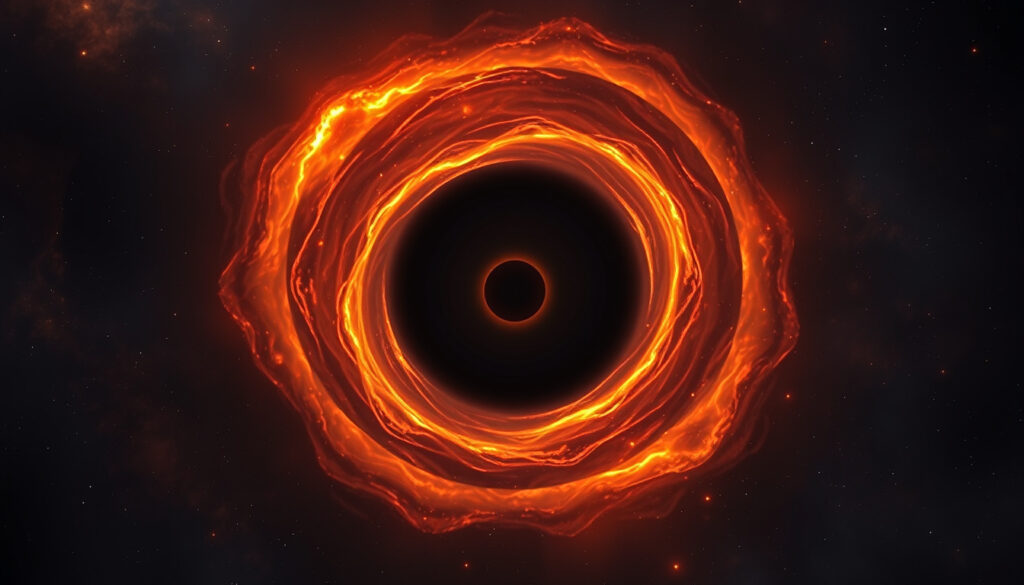
What Is a Black Hole? NASA Basics Explained
Few objects in space spark more wonder than black holes — cosmic oddities so extreme that ordinary physics stops working inside their boundaries. They sound like fiction, but they’re well-documented reality, spotted across the universe by NASA’s Event Horizon Telescope and other instruments. Scientists have now even photographed their shadows, turning abstract math into something you can actually see.
Density: Enormous mass packed into tiny volume · Escape boundary: Event horizon where light cannot escape · Escape velocity: Greater than speed of light · Formation trigger: Collapse of massive stars · Key theory: Einstein’s general relativity
Quick snapshot
- Event horizon exists (NASA Science)
- Formed by stellar collapse (Event Horizon Telescope)
- Detected via gravitational waves (Wikipedia)
- Exact nature of singularity (NASA Space Math)
- Information paradox resolution (Wikipedia)
- Life inside possible (Wikipedia)
- 2019: First black hole shadow imaged by EHT (JPL NASA)
- 1916: Schwarzschild predicted black holes from relativity equations (Wikipedia)
- Closer EHT observations of Sagittarius A* planned (Event Horizon Telescope)
- Continued study of time dilation effects (Wikipedia)
Four key facts about black holes, drawn from decades of theory and recent observations:
| Attribute | Value |
|---|---|
| First predicted | 1916 by Karl Schwarzschild |
| Key observation | 2019 Event Horizon Telescope image |
| Nearest known | Gaia BH1 at 1,560 light-years |
| Evaporation via | Hawking radiation |
What is a black hole in simple terms?
A black hole is an extremely dense object whose gravity is so strong that nothing, not even light, can escape it (NASA Science). According to NASA’s explanation, gravity beneath its surface — the event horizon — prevents any escape. This makes black holes invisible from the outside; they neither emit nor reflect light within their boundaries.
Event horizon explained
The event horizon is the boundary around a black hole beyond which nothing, not even light, can escape due to gravity exceeding the speed of light (NASA Science). Inside this horizon, all paths lead toward the black hole’s center; no escape is possible (Wikipedia). Distant observers never actually see objects reach the event horizon — they appear to slow and redshift infinitely as they approach (Wikipedia).
Why called black hole
Black holes appear black precisely because they neither emit nor reflect light from within the event horizon (NASA Science). NASA describes it this way: “A black hole is so dense that gravity just beneath its surface, the event horizon, is strong enough that nothing — not even light — can escape.”
The pattern holds: what you see is the shadow cast by bent light around the event horizon, not the hole itself. NASA’s Space Math notes that a black hole has three parts: event horizon (visible boundary), interior space (mangled spacetime), and central singularity (NASA Space Math).
Black holes with accretion disks rank among the brightest objects in the universe. Isolated black holes without nearby matter, however, are nearly invisible to telescopes — which is why finding the closest known black hole (Gaia BH1 at 1,560 light-years) required sophisticated detection methods.
What is exactly in a black hole?
No direct observation exists from inside a black hole — by definition, nothing crosses back out to report what it found (Wikipedia). What scientists can detect is the accretion disk of superheated matter circling just outside the event horizon, plus the gravitational effects on nearby stars and gas.
Singularity concept
Theoretically, all the mass compresses into an infinitely dense point called the singularity — but current physics breaks down at that scale (Wikipedia). NASA’s Space Math documentation describes the singularity as the point where known physics no longer applies (NASA Space Math). According to Wikipedia, an event horizon forms before the singularity during gravitational collapse, so the horizon exists independently of what happens inside.
What we observe
The 2019 Event Horizon Telescope image of M87* showed a bright ring of light surrounding a dark shadow — that shadow is roughly twice the size of the actual event horizon due to gravitational lensing (NASA Science). M87* itself has a mass of 6.5 billion solar masses, while Sagittarius A* at our galaxy’s center is 4 million solar masses (JPL NASA).
Matter falling into a black hole would appear to freeze at the event horizon forever from an outside perspective — yet the black hole itself keeps growing. Both are true simultaneously because of how relativity warps time and space.
How is a black hole formed?
Stellar-mass black holes form when massive stars run out of nuclear fuel and their cores collapse under gravity — often during supernova events (Event Horizon Telescope). Supermassive black holes, like Sagittarius A* at our galaxy’s heart, likely grow through a combination of direct gas collapse, merging stellar-mass holes, and repeated feeding (Event Horizon Telescope).
Stellar collapse
When a massive star’s core runs out of fusion fuel, radiation pressure can no longer fight gravity. The core collapses in milliseconds, creating either a neutron star or — if the mass exceeds about three solar masses — a black hole (Event Horizon Telescope). Gravitational wave detectors like LIGO have confirmed this process by observing black hole mergers.
Supermassive origins
Scientists reportedly still debate how supermassive black holes grow to billions of solar masses. Options include direct collapse of massive gas clouds, hierarchical mergers, and sustained feeding on interstellar gas over billions of years (Event Horizon Telescope).
What we do know: the first confirmed image of a black hole shadow came in 2019 when the Event Horizon Telescope released data on M87*, a supermassive black hole 6.5 billion times our Sun’s mass (JPL NASA). This turned decades of theoretical predictions into visual evidence.
What happens if you fall into a black hole?
The experience depends entirely on the black hole’s mass. Stellar-mass black holes kill you with tidal forces long before you reach the horizon. Supermassive black holes allow you to cross the event horizon intact — though what awaits inside remains beyond known physics.
Spaghettification
Tidal forces near black holes stretch objects vertically while compressing them horizontally — a process informally called spaghettification (Wikipedia). Near a stellar-mass black hole, these forces become lethal within thousands of kilometers. Near a supermassive black hole like Sagittarius A*, you could cross the horizon before feeling any stretching at all.
Time dilation
From a distant observer’s perspective, time slows down dramatically near any black hole. Minutes spent near the event horizon could correspond to years or decades passing elsewhere (Wikipedia). This isn’t an illusion — it’s how physics works when gravity warps spacetime itself. Your own experience of time would feel normal; only external observers would see you frozen.
You wouldn’t feel time slowing down from your own perspective — it would feel completely normal right up until tidal forces tear you apart. The weirdness of relativity is that there’s no subjective alarm bell warning you that reality has diverged from what distant observers see.
Are black holes dangerous?
Black holes evaporate over timescales dwarfing the current age of the universe. According to theory, Stephen Hawking proposed that black holes slowly emit thermal radiation (now called Hawking radiation), losing mass in the process — but evaporation takes approximately 10^67 years for stellar-mass holes (Wikipedia).
Threat to Earth
There are no black holes nearby enough to threaten Earth. The closest confirmed stellar-mass black hole, Gaia BH1, sits 1,560 light-years away — far beyond any gravitational influence on our solar system (Event Horizon Telescope). Our galaxy’s central black hole, Sagittarius A*, is roughly 26,000 light-years away, also harmless.
Hawking radiation evaporation
Hawking radiation means black holes aren’t truly black — they emit a faint thermal glow. However, this process is extraordinarily slow for large black holes, so no existing black hole will evaporate for many trillions of years (Wikipedia).
The pattern is reassuring: most large galaxies, including ours, contain supermassive black holes at their centers. This appears to be normal cosmic architecture, not a sign of danger.
Black holes are not cosmic vacuum cleaners that swallow everything indiscriminately. Gravity follows the same rules as everywhere else — you’d need to get remarkably close for the effects to matter. Our solar system is safe for the foreseeable future, and perhaps forever.
“A black hole is an extremely dense object whose gravity is so strong that nothing, not even light, can escape it.”
— NASA Science
“Inside the event horizon, all paths lead toward the black hole’s center. No escape is possible.”
— Wikipedia
Who discovered black holes?
The concept emerged from Karl Schwarzschild’s 1916 solution to Einstein’s relativity equations, showing that sufficiently concentrated mass would prevent light from escaping (Wikipedia). John Wheeler popularized the term “black hole” in 1967, while Roy Kerr extended the theory to rotating black holes in 1963. LIGO’s 2015 gravitational wave detection and the Event Horizon Telescope’s 2019 image provided definitive proof that these objects are real.
For anyone studying the universe, the takeaway is concrete: black holes represent where known physics stops working — and that’s exactly why they’re worth watching. NASA and international observatories continue refining observations of known black holes while hunting for new ones, turning theoretical puzzles into empirical science.
What is a black hole made of?
The composition depends on the region. Outside the event horizon, black holes can have accretion disks of superheated gas and debris. Inside the event horizon, all matter supposedly compresses into the singularity — but what that singularity is made of remains beyond current physics. The short answer: we don’t know exactly what black holes are made of inside.
Who discovered black holes?
Karl Schwarzschild derived the concept from Einstein’s 1916 relativity equations, predicting that sufficiently compressed mass would prevent light escape. John Archibald Wheeler coined the term “black hole” in 1967. Roy Kerr extended the theory to rotating black holes. More recent confirmations came from LIGO’s 2015 gravitational wave detection and the Event Horizon Telescope’s 2019 shadow image.
What is a black hole for kids?
A black hole is a place in space where gravity is so strong that nothing — not even light — can escape. They’re formed when very heavy stars collapse, and they have a boundary called an event horizon. Scientists have taken pictures of the shadows black holes cast using a global network of telescopes called the Event Horizon Telescope.
Can black holes be used for time travel?
Black holes create extreme time dilation — meaning time passes slower near them compared to everywhere else. From an external observer’s view, someone falling toward a black hole would appear to slow down and freeze at the horizon. This effect is real but doesn’t allow backward time travel. You could theoretically return from near a black hole having aged much less than people who stayed on Earth — which is a form of one-way time travel to the future.
How long is 1 minute on a black hole?
There is no fixed conversion. Time dilation near a black hole depends on how close you are to the event horizon. For a supermassive black hole like Sagittarius A*, the effect is relatively gentle near the horizon — minutes for you could translate to years or decades for distant observers. For a stellar-mass black hole, the tidal forces would be lethal before you could meaningfully test this.
What kills a black hole?
Nothing currently threatens black holes — they only slowly evaporate via Hawking radiation over timescales of approximately 10^67 years. No black hole in the universe is close enough to another object that could tear it apart in any practical timeframe. What eventually kills black holes is the theoretical Hawking radiation, which becomes significant only after all other matter has long since decayed.
Can life exist in a black hole?
Current physics suggests life cannot exist inside a black hole. The environment inside the event horizon — characterized by extreme tidal forces, spaghettification physics, and the crushing singularity — is incompatible with known biology. Any matter crossing the horizon inevitably moves toward the singularity in finite proper time. However, certain stable orbits outside the event horizon might theoretically support life-bearing planets for a time.
Related reading: What Is a Liberal? Definition, Beliefs & Politics · What Is a Roth IRA? How It Works, Vs 401k & Eligibility
More related posts
 State Farm Home Insurance: Reputation, Cost & Complaints 2026
 New Streaming This Weekend: Top Movies & Shows to Binge
 Ashwagandha Benefits for Women: Hormones, Stress Relief
 Where to Watch Coraline: Netflix, Tubi & More (2025)
 CarMax Sell My Car: No-Haggle Process and Offer Tips
 Venmo Customer Service Number: Phone, Chat & Support Guide
 Choice Home Warranty Awards 2026: Ratings, Reviews & Insights
 KPop Demon Hunters 2: Facts, Theories & What’s Not Confirmed