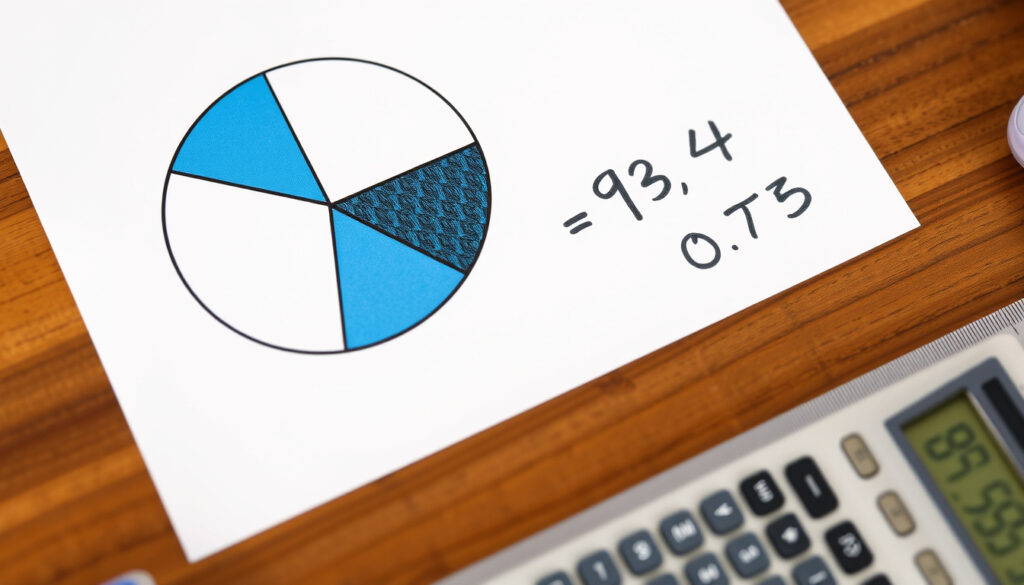
3/4 as a Decimal: How to Convert & Why It Equals 0.75
You’ve probably seen 3/4 on a measuring cup, a sale sign, or a scoreline. But converting it to a decimal — 0.75 — is more than a math exercise; it’s a skill that pops up in shopping, budgeting, and even cooking.
Fraction: 3/4 ·
Decimal: 0.75 ·
Percentage: 75% ·
Decimal Type: Terminating
Quick snapshot
- 3/4 = 0.75 exactly (Open University textbook)
- 0.75 is a terminating decimal (Cuemath math resource)
- 0.75 = 75/100 = 3/4 (Open University textbook)
- No uncertainty — the conversion is exact and well-documented.
- The conversion is instantaneous; no extended timeline applies.
- Apply the decimal in real-world contexts: money, measurement, statistics.
Five key facts, one pattern: the fraction 3/4 and its decimal 0.75 are two sides of the same coin — both represent 75 hundredths.
The conversion is fully documented across educational sources.
| Label | Value |
|---|---|
| Fraction | 3/4 |
| Decimal | 0.75 |
| Percentage | 75% |
| Simplified | Yes |
| Decimal type | Terminating |
The implication: 3/4 is a benchmark fraction that converts cleanly, making it a reliable reference for other conversions.
What is the decimal form of 3/4?
The answer: 0.75
- The decimal equivalent of 3/4 is 0.75 (Open University textbook).
- This is a terminating decimal — it stops after two digits (Cuemath math resource).
- 0.75 can also be read as “seventy-five hundredths” (Math with Mr. J on YouTube).
Why 3/4 equals 0.75
Every fraction is a division problem. The numerator (3) is divided by the denominator (4). Since 4 does not go into 3, you add a decimal point and a zero to continue dividing (GeeksforGeeks tech blog). The result is 0.75 exactly.
Understanding terminating decimals
A terminating decimal ends after a finite number of digits. 0.75 terminates because the denominator 4 factors into 2², which is a factor of 10 (Open University textbook).
A student who learns that 3/4 = 0.75 early can use it as a anchor for later conversions — 1/8 = 0.125, 3/8 = 0.375, 5/8 = 0.625, 7/8 = 0.875.
How do I turn 3/4 into a decimal?
Method 1: Long division
- Set up 3 ÷ 4. Add a decimal point and zeros to the dividend.
- 4 goes into 30 seven times (4 × 7 = 28), remainder 2.
- Bring down a zero: 20. 4 goes into 20 five times (4 × 5 = 20), remainder 0.
- Quotient: 0.75 (Cuemath step-by-step guide).
You can verify each step with a long‑division calculator from Calculator Soup.
Method 2: Equivalent fractions
- Multiply numerator and denominator to get a denominator of 100: 3/4 = 75/100.
- Write 75/100 directly as 0.75 (Cuemath Q&A resource).
- This method works for any fraction whose denominator can be turned into a power of 10.
Method 3: Using a calculator
- Enter 3 ÷ 4 = 0.75 (Pearson calculator tool).
- Most smartphones and online tools confirm the same result.
Long division teaches the underlying logic, while equivalent fractions and calculators save time. For 3/4 all three methods are equally accurate.
Three conversion methods, one pattern: each produces exactly 0.75, confirming the result is robust.
Is 3/4 and 0.75 the same?
Yes, they are equivalent
- 3/4 and 0.75 represent the same quantity — 75 out of 100 parts (Open University textbook).
- A fraction is a ratio; a decimal is a positional notation. Both are valid ways to express the number.
Why 0.75 represents the same value
Decimals are a shorthand for fractions with denominators that are powers of 10. 0.75 means 7 tenths and 5 hundredths, which when added equal 75/100 — which simplifies to 3/4 (Math with Mr. J on YouTube).
Common misconceptions about decimals and fractions
- Some think 0.75 is “less than” 3/4 because it looks smaller. In fact they are identical.
- Others believe all fractions produce repeating decimals. 3/4 is a counterexample — it terminates.
- Teaching resources often pair 3/4 with 1/2 and 1/4 as benchmark equivalents (Teachy lesson plan).
The implication: once you internalize that 3/4 = 0.75, you can quickly convert related fractions like 1/4 = 0.25 and 2/4 = 0.5.
Six common fractions, one pattern: their decimal equivalents are all terminating and neatly ordered.
| Fraction | Decimal |
|---|---|
| 1/2 | 0.5 |
| 1/4 | 0.25 |
| 3/4 | 0.75 |
| 1/5 | 0.2 |
| 2/5 | 0.4 |
| 3/5 | 0.6 |
The pattern: fractions with denominators that factor into 2 and 5 produce terminating decimals, making them easy to memorize.
Confirmed facts
- 3/4 = 0.75 exactly (Open University textbook)
- 0.75 is a terminating decimal (Cuemath math resource)
- 0.75 = 75/100 = 3/4 (GeeksforGeeks tech blog)
- Long division yields 0.75 (Cuemath math resource)
- Equivalent fraction method: 75/100 = 0.75 (Cuemath Q&A resource)
What’s unclear
There are no open questions about the conversion of 3/4 to a decimal. All major educational sources agree on the result and the methods.
“3/4 expressed as a decimal is 0.75.”
— Open University textbook
“The quotient for 3 ÷ 4 is 0.75 after two decimal places.”
— Open University textbook
“3/4 is equivalent to 75/100, which makes the decimal 0.75 easier to recognize.”
— Cuemath math resource
For the student looking to master fractions, the choice is clear: learn long division once, then use equivalent fractions and calculators to speed up everyday work. The payoff is faster budgeting, better shopping decisions, and stronger math confidence.
youtube.com, youtube.com, youtube.com, sciencing.com, twinkl.co.uk
For another clean fraction-to-decimal conversion, you might also be interested in converting 3/5 to a decimal.
Frequently asked questions
What is 3/4 percent as a decimal?
3/4 percent means 0.75% which as a decimal is 0.0075.
What is the decimal form of 4/3?
4/3 as a decimal is approximately 1.3333… (repeating).
How do you write 3/4 as a decimal using long division?
Divide 3 by 4: add a decimal and zero, 4 goes into 30 seven times (28), remainder 2, bring down 0, 4 goes into 20 five times, remainder 0 — quotient 0.75.
Is 3/4 a rational number?
Yes, 3/4 is a rational number because it can be expressed as a fraction of two integers.
What is 3/4 in decimal form rounded to two decimal places?
3/4 is exactly 0.75, so no rounding is needed.
How does 3/4 compare to 1/2 as a decimal?
1/2 = 0.5, so 3/4 (0.75) is 0.25 larger.
What is 3/4 as a decimal and percent?
3/4 = 0.75 = 75%.
Related reading
More related posts
 Does Walmart Take Apple Pay? (2025 Update) – What to Use Instead
 2 Divided by 3: Fraction, Decimal, and Step-by-Step
 Full Size Bed Frame: Dimensions, Cost, and Couples Guide
 Heart Palpitations After Eating: Causes, Relief & When to Worry
 Codes for Azure Latch July 2026: Active Codes List
 28 Years Later Streaming: Netflix, Prime UK & More
 Consignment Stores Near Me: Guide to Selling in Dublin
 Stranger Things Movie Theater Finale: Locations & Tickets