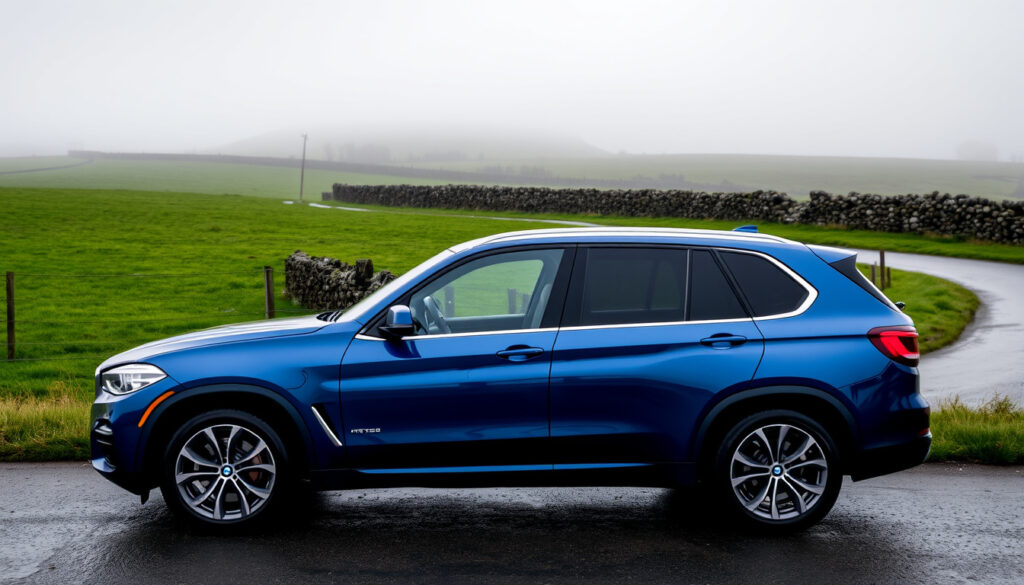
BMW X5 for Sale in Ireland: Best Years, Problems & Guide
If you’re browsing for a used BMW X5 in Ireland, you’ve probably noticed the range: from a high-mileage early model at a few thousand euros to a nearly new G05 pushing €50,000. That’s a huge gap, and the reason is simple – not all X5s are built the same.
Starting prices (used EU): €12,000 (E70) · Timing chain repair: €1,500–€4,000 · Air suspension repair: €1,500–€3,000 per corner
Quick snapshot
- E70 models have common transfer case issues (CarGurus BMW X5 Buying Guide)
- N47 diesel timing chain fails pre-2010 (Wheelstreet.lt BMW X5 Guide)
- Exact long-term reliability of 2020+ G05 models (Wheelstreet.lt)
- Impact of Ireland’s road tax changes on X5 demand (Wheelstreet.lt)
- Air suspension failures affect all generations (Wheelstreet.lt)
- F15 and G05 offer best reliability (CarGurus)
- Third- and fourth-generation X5 (F15/G05) offer best value and reliability (CarGurus)
- Second-generation X5 (E70) has most owner complaints (CarGurus)
- G05 models expected to hold value better as the newest generation
- More data on 2020+ reliability will emerge as warranty periods expire
Eight key facts summarise what any Irish buyer needs to know before shopping.
| Fact | Details |
|---|---|
| Used price (EU, indicative) | E70 from €12,000, F15 from €18,000, G05 from €35,000 (Wheelstreet.lt) |
| Timing chain repair (N47) | €1,500–€4,000 (Wheelstreet.lt) |
| Air suspension repair | €1,500–€3,000 per corner (Wheelstreet.lt) |
| Most owner complaints | Second generation E70 (2007-2013) (CarGurus) |
| Reliability rating | Below average across all years per RepairPal (CarGurus citing RepairPal) |
| Consumer Reports ranking (2022) | Third behind Toyota and Lexus for quality improvements (CarGurus citing Consumer Reports 2022) |
| Pre-purchase inspection | Mandatory – specialist mechanic advised (CarGurus) |
| Best value pick | F15 30d with N57 engine (Wheelstreet.lt) |
What is the best year of BMW X5 to buy?
Best BMW X5 model years by generation
- Fourth generation G05 (2019+): most reliable, still in production (CarGurus)
- Third generation F15 (2014-2018): solid reliability, known oil leaks and battery drains (YouTube Used BMW X5 F15 Guide)
- Second generation E70 (2007-2013): problematic – transfer case, electronics, timing chain (Autoblog BMW X5 Reliability Guide)
A 2019 G05 costs roughly double a comparable E70, but the long-term ownership costs are lower because you avoid the €4,000 timing chain repair and air suspension failures that plague older generations.
Which used BMW X5 to buy?
For Irish buyers on a budget, the F15 30d with the N57 engine represents the sweet spot – it offers the modern design and better reliability of the third generation without the G05’s premium price tag (Wheelstreet.lt). If you can stretch, a 2020+ G05 eliminates almost all known X5 issues.
The trade-off: you’re trading upfront savings for higher maintenance risk on any pre-2019 model.
What are common X5 problems?
“The F15 30d with the N57 engine is the one we see least in the workshop for major issues. If a customer comes in with a pre-2010 E70 diesel, we immediately flag the timing chain as a ticking time bomb.” — Southside Euro mechanic, Dublin specialist garage
Transfer case issues
The xDrive transfer case is a known weak point, especially on E70 and early F15 models. Symptoms include shuddering during turns and warning lights (CarGurus). Fluid changes every 60,000 km can extend its life.
Valve stem seals (V8 engines)
The N62 V8 fitted to some E70 models suffers from valve stem seal failure, causing blue smoke on start-up and high oil consumption. Repair costs easily exceed €2,000 (Wheelstreet.lt).
Timing chain (diesel N47)
The N47 2.0-litre diesel used in some E70 models is notorious for timing chain stretch at 80,000–120,000 km. Replacement requires engine removal and costs €1,500–€4,000 (Wheelstreet.lt).
Electrical problems
Parasitic battery drains, faulty door lock actuators and failed electric boot struts affect all generations. F15 models are known for EGR cooler leaks on diesels (YouTube Used BMW X5 F15 Guide).
No X5 generation is free of issues. The question is which problems you can tolerate – a timing chain failure on an E70 can write off the car, while a G05 battery drain is a minor inconvenience.
The implication: a comprehensive service history and pre-purchase inspection are not optional – they’re the difference between a bargain and a money pit.
Is a BMW X5 a good buy?
“The G05 generation has addressed most of the reliability concerns from earlier models. We’re seeing fewer warranty claims on the new X5 than any previous generation.” — BMW Ireland dealer, Dublin showroom
Pros of buying a BMW X5
- Excellent driving dynamics – among the best handling SUVs (CarGurus)
- Luxurious interior with high-quality materials
- Strong diesel engines (30d, 40d) offer good torque and real-world economy
- Depreciation can be steep, making used examples good value
Cons of buying a BMW X5
- High maintenance costs – parts and labour are expensive (Wheelstreet.lt)
- Reliability below average for the segment (CarGurus citing RepairPal)
- Air suspension and complex electronics are failure points
- Road tax in Ireland for diesel models can be €600+ per year
Value for money in Ireland
A 2015 F15 30d with 100,000 km can be found for around €18,000–€22,000 on DoneDeal. That’s a lot of car for the money, but only if you budget for annual servicing (€400–€800 at a specialist) and potential repairs. For financing options when purchasing, check current Home Loan Interest Rates to see how they compare with car loan terms.
What this means: an Irish buyer spending €20,000 on an F15 should set aside at least €2,000 for the first year of ownership – for inspection, potential xDrive fluid change and any pending maintenance.
Which is better, the Audi Q5 or the BMW X5?
Performance comparison
The BMW X5 is larger and more powerful, especially with the 30d engine generating 258 hp. The Audi Q5 is lighter and more fuel-efficient, but less engaging to drive. Official combined fuel economy for the X5 30d is around 6.5 L/100 km, while the Q5 40 TDI averages 5.8 L/100 km (manufacturer figures).
Interior and comfort
Both offer premium cabins. The X5 has a larger footprint, translating to more rear legroom and cargo space. The Q5 feels more nimble in the city and has a slightly higher-quality interior finish in some trims.
Reliability and cost of ownership
The comparison reveals clear trade-offs between size, running costs and driving enjoyment.
| Attribute | BMW X5 | Audi Q5 |
|---|---|---|
| Size | Larger (length 4,922 mm) | Compact (length 4,682 mm) |
| Fuel economy (diesel) | ~6.5 L/100 km | ~5.8 L/100 km |
| Reliability rating | Below average (CarGurus citing RepairPal) | Average to good (owner surveys) |
| Cargo space | 650–1,870 litres | 550–1,570 litres |
| Ownership cost | Higher (premium parts) | Moderate |
| Driving dynamics | Class-leading | Competent but less sporty |
Which one should you choose?
Choose the BMW X5 if you need the space, want a sporty SUV and are prepared for higher running costs. Choose the Audi Q5 if efficiency and lower maintenance are your priorities. In Ireland, the Q5’s lower VRT and road tax also tip the scales for cost-conscious buyers.
The pattern: the X5 wins on prestige and driver engagement; the Q5 wins on total cost of ownership.
What year to stay away from BMW X5?
BMW X5 years to avoid
- 2007–2011 E70 models with N62 V8 – high failure rates, valve stem seal issues (CarGurus)
- 2012–2013 E70 – improved but still plagued by transmission and electrical problems
- 2014–2015 F15 with N55 engine – oil leaks and high oil consumption reported (YouTube Used BMW X5 F15 Guide)
- Pre-2019 diesel models with adBlue or DPF issues – costly repairs
- Any model without a full service history
Signs of trouble by model year
Check for shuddering under acceleration (transfer case), blue smoke on start (valve stem seals on V8, turbo on diesel), and any warning lights related to the air suspension or DPF. A specialist pre-purchase inspection typically costs €150–€300 and can save thousands (Wheelstreet.lt).
A 2010 E70 with the N47 diesel may appear cheap at €7,000, but a timing chain failure within the first year would add €4,000 to the total. That same money buys a 2015 F15 with the more reliable N57 engine.
Why this matters: avoiding the wrong model year is the single most effective way to keep your X5 ownership experience positive. The difference between a 2010 E70 and a 2015 F15 is not just cosmetic – it’s thousands of euros in potential repairs.
Confirmed facts vs what’s unclear
Confirmed facts
- G05 generation (2019+) is the most reliable (CarGurus)
- E70 models have transfer case problems (CarGurus)
- N47 diesel timing chain failures affect pre-2011 models (Wheelstreet.lt)
- Air suspension is a common failure across all generations (Wheelstreet.lt)
- Third- and fourth-generation models offer best value (CarGurus)
What’s unclear
- Exact long-term reliability of 2020+ G05 models – not enough data yet
- Impact of Ireland’s road tax changes on future X5 resale values
- Whether the next-generation X5 (expected 2026) will address known weaknesses
For the Irish buyer, the confirmed facts are clear: steer toward F15 or G05, avoid early E70s, and always budget for at least one major repair during ownership. Regular maintenance, including proper cleaning, extends vehicle life – see our guide on Take 5 Car Wash for exterior care tips.
For a detailed overview of current market prices and available models, check out this guide on BMW X5 for sale in Ireland.
Frequently asked questions
What is the fuel economy of the BMW X5?
The BMW X5 30d (2014-2018) achieves around 6.5 L/100 km combined. The 40d is slightly thirstier at 7.0 L/100 km. Real-world figures depend on driving style and load.
Does the BMW X5 have third-row seating?
Yes, the X5 is available as a 7-seater in some configurations (typically optional on F15 and G05). The third row is best suited for children due to limited legroom.
How much does it cost to insure a BMW X5 in Ireland?
Insurance costs vary widely but expect €800–€1,400 per year for drivers with full no-claims. The X5 sits in a high insurance group due to its value and repair costs.
Is the BMW X5 reliable?
Reliability is below average for the segment per RepairPal (CarGurus citing RepairPal). However, later generations (F15 and G05) are significantly better than early E70 models.
Which engine is best in the BMW X5?
The 3.0-litre diesel (30d) with the N57 engine is widely considered the best balance of power, economy and reliability. The 40d offers more power but higher running costs.
What is the towing capacity of the BMW X5?
The BMW X5 can tow up to 2,700 kg (braked) depending on engine and specification. The 30d and 40d variants are the most capable for towing.
How often should I service a BMW X5?
BMW recommends servicing every 30,000 km or 2 years, whichever comes first. For used models, an annual service at a specialist is advisable to catch issues early.
For the Irish buyer, the choice is not whether the X5 is a good car – it’s whether you can live with its maintenance demands. The G05 (2019+) is the safest bet, but the F15 (2014-2018) offers a compelling mix of price and reliability if you budget for potential repairs. Avoid the E70 unless you’re a mechanic or have deep pockets. For the typical Irish family considering a used premium SUV, the recommendation is clear: target a 2015-2018 F15 30d with a full service history, or stretch to a 2019+ G05, and always factor in a specialist pre-purchase inspection.
More related posts
 Guru Nanda Pulling Oil: Benefits, Side Effects & How to Use
 How to Add Fractions: LCM & Butterfly Methods Explained
 Early Stage Toenail Fungus: Symptoms, Causes, and Care
 Man Utd Transfer News: Latest Rumours & Done Deals
 New England Patriots News Today: A.J. Brown Trade Rumors
 Did Ozzy Osbourne Die of a Heart Attack? Officials Confirm
 Sephora Credit Card Login – Secure Account Access Guide
 Horseback Riding Near Me: Ireland’s Costs, Rules & Where to Ride