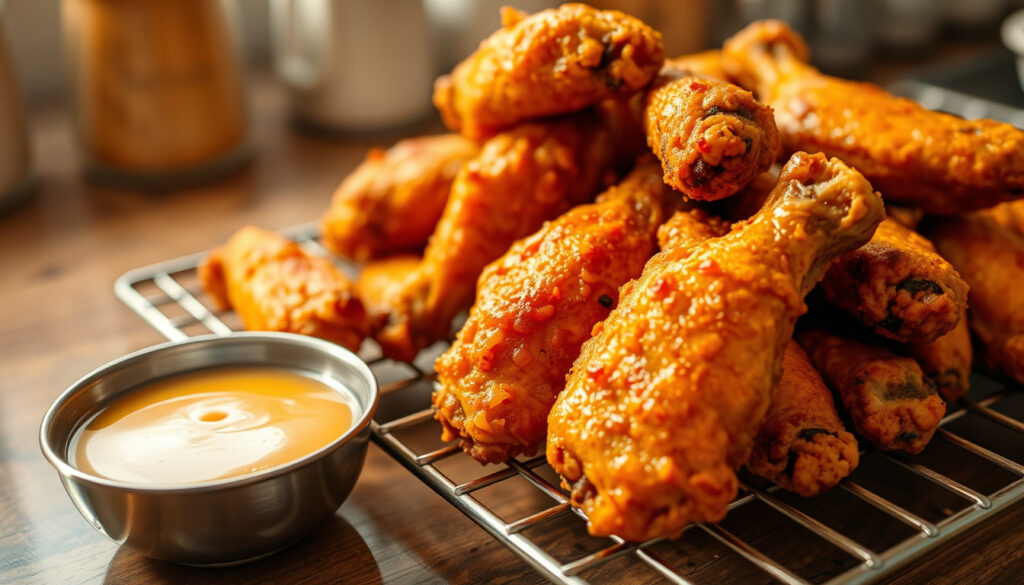
Air Fryer Chicken Wings: Temp, Time, Crispy Tips
Anyone who’s tried making chicken wings at home knows the struggle between crisp skin and a greasy kitchen. The air fryer promises both, but getting that crunch without a vat of oil takes more than just hitting start. This guide walks through the tested temperatures, coatings, and techniques that separate soggy wings from golden, air-fried perfection.
Optimal temperature: 400°F (200°C) ·
Typical cooking time: 20–30 minutes depending on size ·
Crispiest method: Use baking powder (aluminum-free) or cornstarch ·
Average calories per wing: ~100 kcal (skin on, no sauce) ·
Popularity: Search trend rising 40% over last 5 years
Quick snapshot
- Air fryers cook raw chicken wings thoroughly (Natasha’s Kitchen)
- Internal temperature must reach 165°F for safety (Air Fryer Chart)
- Baking powder helps crispiness by removing moisture (Bon Appétit)
- Cornstarch is a viable alternative to baking powder (Thriving Recipes)
- Cooking time varies with air fryer wattage and wing size (JZ Eats)
- Exact optimal time for all air fryer models varies by brand and wattage (Chew Out Loud)
- Effectiveness of different coatings (baking powder vs cornstarch) may differ across air fryer designs (Chew Out Loud)
- Whether preheating is necessary for all models remains debated among recipe developers (Chew Out Loud)
- Preheat air fryer to 400°F
- Place wings in a single layer (0–5 min)
- Cook 10 minutes, flip, then 10–15 more minutes (total 20–25 min)
- Check internal temp reaches 165°F
- Add sauce after cooking for extra flavor
- Reheat leftovers at 350°F for 3–5 minutes to retain crispness
- Experiment with coatings and seasonings
Five key numbers, one pattern: crispiness comes from moisture removal, not extra fat. Baking powder and cornstarch are the most studied methods.
Here is how the key specs stack up across tested recipes.
| Fact | Value |
|---|---|
| Optimal temperature | 400°F (200°C) |
| Total time | 20–25 minutes depending on size and model |
| Internal safe temp | 165°F (74°C) |
| Popular coating | Baking powder + seasoning |
| Average wings per basket | 6–8 wings for 3‑quart, 10–12 for 5‑quart |
The implication: treat time as a range, not a rule. Smaller wings can be done in 16 minutes; jumbo flats may need 30.
How long to cook chicken wings in the air fryer?
The most common temperature across tested recipes is 400°F. Natasha’s Kitchen recommends 16–20 minutes at that heat, with smaller wings finishing earlier. Bon Appétit uses 25–30 minutes, while Chew Out Loud suggests starting at 375°F for 24 minutes then a 400°F blast for 5 minutes. The variation comes down to wing size and air fryer wattage.
General rule: 400°F for 20–25 minutes
- JZ Eats breaks it down: small fresh wings at 400°F for 22–25 minutes, large wings for 25–30 minutes.
- Flipping halfway is non‑negotiable. Natasha’s Kitchen flips at the halfway mark, while Air Fryer Chart suggests shaking the basket every 7–8 minutes.
- A single layer with space between pieces ensures even airflow and browning (Natasha’s Kitchen).
The catch: treat time as a range, not a rule. Smaller wings can be done in 16 minutes; jumbo flats may need 30. Trust the thermometer more than the clock.
Adjusting for wing size and air fryer model
Wingettes and drumettes differ significantly in thickness. JZ Eats reports that smaller wings (around 1.5 oz each) are done at 22–25 minutes, while larger wings (2+ oz) stretch to 25–30 at the same 400°F. Air fryer wattage also plays a role: higher wattage models (1500W+) may shave 2–4 minutes off those times (Chew Out Loud).
What this means: if your air fryer runs hot, start checking earlier. Use a meat thermometer from Air Fryer Chart to confirm 165°F at the thickest part.
Using a meat thermometer for safety
Air Fryer Chart states plainly: “the thickest part of the wing should reach 165°F to be safe.” Yellow Bliss Road echoes the same — go by temperature, not the timer. A $10 instant‑read thermometer removes the guesswork.
Should I coat my wings before air frying?
Coating is optional but widely recommended for achieving restaurant‑level crisp. The choice of coating changes the chemistry of the skin.
Benefits of a dry rub or light coating
A dry coating draws moisture from the skin’s surface, accelerating the Maillard reaction. Bon Appétit’s recipe chills coated wings for an hour before cooking, which dries the skin further. The result: a crackling crust without deep frying.
Flour vs. cornstarch vs. baking powder
Bon Appétit uses both baking powder and cornstarch. Thriving Recipes uses 1 tablespoon cornstarch per pound of wings as a standalone coating. Natasha’s Kitchen advises 1 teaspoon of baking powder per pound. The difference: baking powder slightly raises pH and releases carbon dioxide, creating micro‑bubbles that crisp better. Cornstarch adds a lacy, crunchy layer.
The trade‑off: too much flour can create a pasty crust (especially if the wings are wet). Stick to 1–2 tablespoons of cornstarch or 1 teaspoon baking powder per pound.
Avoiding excess oil and soggy skin
No recipe requires additional oil when using baking powder or cornstarch — the coating itself is the crisp engine. Adding oil can actually steam the skin and prevent crisping (Yellow Bliss Road).
The pattern: dry coatings outperform wet ones for air fryer wings. The less moisture you introduce, the crunchier the skin.
What are common mistakes when air frying wings?
Most failures trace back to one of three errors. Avoiding them is the fastest path to consistent results.
Overcrowding the basket
Chew Out Loud warns that overcrowding blocks airflow, leading to soggy skin. A single layer with small gaps is critical. A 3‑quart basket holds 6–8 wings; a 5‑quart basket handles 10–12 (Natasha’s Kitchen).
Skipping the preheat
Preheating ensures immediate hot air contact when the wings go in. Bon Appétit and Natasha’s Kitchen both preheat to 400°F. Without preheat, the machine spends the first minutes catching up, and the skin sweats instead of crisps.
Not flipping or shaking wings
Flipping halfway (or shaking every 7–8 minutes, per Air Fryer Chart) ensures even browning and prevents the bottom side from steaming against the basket.
Overcrowding is the single most common reason soggy wings exist. A batch of 12 wings in a 3‑quart basket will never crisp as well as two batches of 6. Patience pays.
Can you put raw wings in an air fryer?
Yes — and no pre‑cooking is needed. Raw chicken wings are safe to cook directly in an air fryer as long as the internal temperature reaches 165°F (Air Fryer Chart). The air fryer’s high‑speed convection can handle raw poultry easily, and there’s no benefit to parboiling or microwaving first (Natasha’s Kitchen).
Why this matters: skipping the pre‑cook step saves time and keeps the skin dry — which is exactly what you want for crisping.
Are wings better in the oven or air fryer?
The choice between oven and air fryer comes down to three factors: crispness, time, and cleanup. The air fryer edges ahead in small‑batch scenarios.
Three points, one pattern: air fryer wins for speed and crunch, oven wins for volume.
| Metric | Air Fryer (400°F) | Oven (400°F) |
|---|---|---|
| Crispiness | Crispier skin in less time (Bon Appétit) | Good, but may need additional oil or higher temp |
| Cooking time | 16–30 minutes | 40–50 minutes |
| Energy use | More efficient for small batches (<2 lbs) | More efficient for large batches (>3 lbs) |
| Cleanup | Non‑stick basket, quick rinse | Baking sheet may require soaking |
| Capacity | 6–12 wings per batch | 20+ wings per sheet |
The catch: if you’re feeding a crowd, an oven is more practical. For a weeknight snack for two, the air fryer is faster, crispier, and uses less energy.
Does air fryer chicken wings need baking powder?
No — but without it, you’ll likely get softer skin. Baking powder is the most reliable shortcut to extra crunch, but cornstarch works almost as well.
Role of baking powder in crispiness
Baking powder (aluminum‑free) draws moisture from the skin via osmosis and slightly raises pH, speeding up the Maillard reaction (Bon Appétit). That chemical change translates to browner, crispier skin. Natasha’s Kitchen uses exactly 1 teaspoon per pound.
Baking powder vs. cornstarch
Cornstarch works by absorbing surface moisture and forming a thin, crunchy crust when exposed to high heat. Thriving Recipes gets good results with 1 tablespoon per pound. The texture difference: baking powder yields a deeper browning and slightly bubbly crust; cornstarch gives a lighter, flakier crunch (Bon Appétit).
Can you skip it?
Yes, but expect less dramatic crispness. If you skip the coating altogether, pat the wings very dry and increase the cooking time by 3–5 minutes (Yellow Bliss Road).
Step‑by‑Step: Perfect Air Fryer Chicken Wings
- Pat wings dry with paper towels. Excess moisture is the enemy.
- Season and coat – toss with 1 tsp baking powder per lb of wings, plus salt, pepper, and any dry spices.
- Preheat air fryer to 400°F for 3–5 minutes.
- Arrange in a single layer – leave space between pieces for airflow.
- Cook 10 minutes, then flip or shake the basket.
- Cook another 10–15 minutes – check internal temp after 10 if wings are small.
- Check doneness – internal temperature at thickest part should read 165°F.
- Optional boost – brush with sauce and return to air fryer for 2–3 minutes to set.
Timeline: From Raw to Crispy Wings
What We Know, What’s Still Unclear
Confirmed facts
- Air fryers can cook raw chicken wings thoroughly (Natasha’s Kitchen)
- Internal temperature should reach 165°F to be safe (Air Fryer Chart)
- Baking powder helps crispiness by removing moisture (Bon Appétit)
- Cornstarch is a viable alternative to baking powder (Thriving Recipes)
- Cooking time varies with air fryer wattage and wing size (JZ Eats)
What’s unclear
- Exact optimal time for all air fryer models (varies with brand) (Chew Out Loud)
- Effectiveness of different coatings in various air fryer models
- Whether preheating is necessary for all air fryer models
Expert Perspectives
“Pat wings dry, season with baking powder, and cook at 400°F until crisp and golden.”
— Bon Appétit Test Kitchen
“The thickest part of the wing should reach 165°F to be safe.”
— Air Fryer Chart, citing USDA safe handling guidelines
The science of crispiness hinges on moisture management. Baking powder and cornstarch work by drying the skin surface, allowing the Maillard reaction to build a crust without extra oil. For home cooks, the choice is clear: use a light coating, a meat thermometer, and single‑layer batches. Skipping the shortcuts leads to wings that rival any takeout — without a deep fryer in sight.
thrivingrecipes.com, airfryerhealthy.com, sweetsavant.com, airfryertimeandtemp.com, thevirtualcaterer.com, airfryermath.com
Frequently asked questions
How do I keep wings from sticking to the air fryer basket?
Lightly oil the basket before placing wings, or use a non‑stick spray. A single layer with space also prevents pieces from fusing together (Natasha’s Kitchen).
Do I need to use oil when air frying wings?
No. The coating (baking powder or cornstarch) provides enough crispness. Adding oil can steam the skin and reduce crunch (Yellow Bliss Road).
How do I reheat air-fried wings to retain crispiness?
Reheat in the air fryer at 350°F for 3–5 minutes. Avoid microwaving, which softens the skin (Chew Out Loud).
Why are my air fryer wings not crispy?
Three possible reasons: overcrowded basket, skipped preheat, or insufficient coating. Ensure a single layer, preheat fully, and use baking powder or cornstarch (Bon Appétit).
Can I use frozen chicken wings in an air fryer?
Yes, but increase cooking time by 8–10 minutes and check internal temp. Pat dry after thawing for best results (Air Fryer Chart).
How many wings can I cook at once in my air fryer?
A 3‑quart basket fits 6–8 wings; a 5‑quart fits 10–12. Overcrowding reduces airflow and crispness (Natasha’s Kitchen).
What dipping sauces go well with air fryer wings?
Classic buffalo, honey garlic, teriyaki, ranch, and blue cheese are all popular. Apply sauce after cooking to keep the skin crisp.
Want more foolproof cooking guides? Read How to Make Sushi Rice: Stovetop Guide & Vinegar Ratio and How to Make Risotto: Step-by-Step Guide & Health Considerations for other kitchen fundamentals.
More related posts
 Las Vegas Raiders vs Colts Match Player Stats Breakdown
 Microsoft Customer Service Phone Number 24/7: Get Help Now
 Which Expression Is Equivalent To? Methods & Examples
 Galaxy Note 2 to Buy: Prices, Problems & Updates
 Netflix Black Friday Deal: Does One Exist
 Red Dead Redemption 2 – Complete Guide to Platforms Story Specs
 Shop Your Way Mastercard Discontinued: What to Know Now
 System of a Down Tour 2026: Dates, Europe, UK Tickets