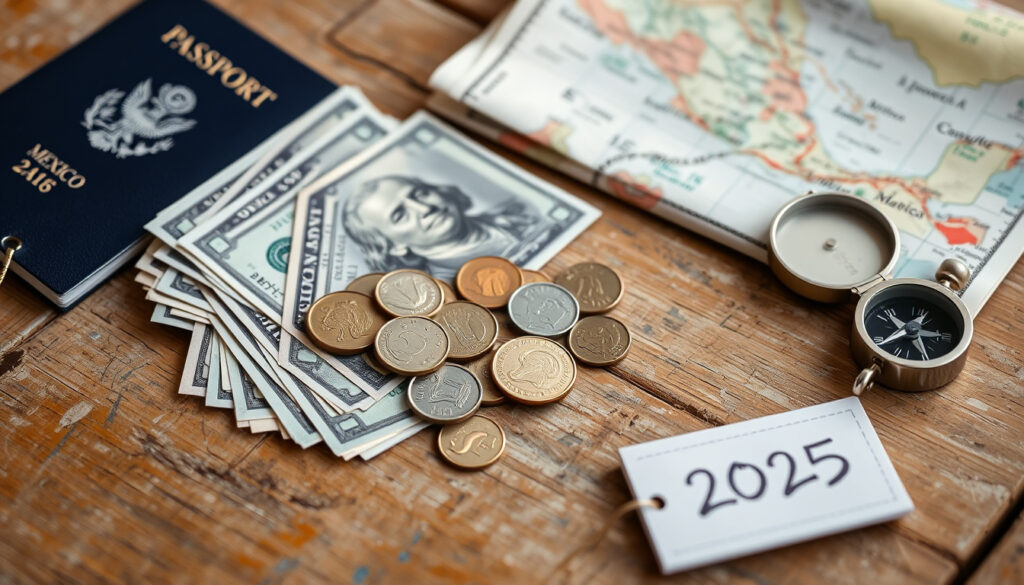
Dollar to Mexican Peso: 2025 Exchange Rates & Travel Tips
You’ve booked your Mexico getaway and now you’re facing the currency question: dollars or pesos? This guide walks through exchange rates, tipping norms, and budget strategies to help you spend smarter south of the border.
Recommended advance exchange: $200–$300 USD per person ·
Dynamic currency conversion markup: 5–10% ·
Best withdrawal method: bank ATMs over airport kiosks
Quick snapshot
- Pesos are the safer default for everyday spending (Exceptional Villas travel guide)
- Bank ATMs offer better rates than airport booths (You Pack I Plan)
- Notify your bank before travel to avoid card blocks (Where Sidewalks End)
- Exact exchange rates at specific booths vary widely (Expat Insurance)
- Whether the peso will continue strengthening in 2026 is uncertain (Cancun Currency Exchange Guide)
- Dynamic currency conversion fees depend on card issuer policies (Where Sidewalks End)
- Q4 2024 – Q1 2025: Peso strengthened from near 18 to low 17s against USD (The Cancun Sun)
- March 2025: USD/MXN rate around 17.35, analysts expect further rally in 2026 (XE)
- 2026 forecast: Continued peso strength due to nearshoring and high interest rates (OANDA)
- Check current rate on XE or OANDA before departure
- Withdraw pesos from bank ATMs after arrival (Expat Insurance)
- Use credit cards with no foreign transaction fees to avoid DCC markups (XE)
The table below condenses essential currency facts for US travelers.
| Fact | Details |
|---|---|
| Where USD is accepted | Major resorts, hotels, and some large restaurants in tourist zones (Expat Insurance) |
| Where USD is NOT accepted | Local restaurants, street food vendors, small shops, and smaller towns (Exceptional Villas) |
| Best exchange method | Withdraw pesos from bank ATMs in Mexico (You Pack I Plan) |
| Worst exchange method | Airport currency exchange booths (poor rates) (You Pack I Plan) |
| Cash vs card recommendation | Use pesos for cash purchases, use a no-fee credit card for larger expenses, decline DCC (Expat Insurance) |
| ATM withdrawal tip | Make larger, less frequent withdrawals to minimize fixed fees (Where Sidewalks End) |
What is the current USD to MXN exchange rate?
Mid-market rate vs. retail rates
The mid-market rate is the wholesale rate banks use among themselves — you won’t get it at an airport kiosk. In early 2025 the peso has been hovering near 17.35 per dollar, but retail exchange booths typically add a spread of 3% to 8%. show live mid-market rates.
- Mid-market: ~17.35 MXN per USD (March 2025) – check XE or OANDA for real-time
- Airport kiosk: often 16.5–17.0 MXN per USD (You Pack I Plan)
- Bank ATM: near mid-market rate plus a small fee (usually 1–2%)
Paying in pesos at a bank ATM gives you the closest rate to mid-market. Airport booths cost you roughly 3–8% more — that’s $3–$8 lost for every $100 exchanged.
Where to find live exchange rates
Use XE or OANDA for a live mid-market snapshot. Banco de México publishes official daily rates but they’re less convenient for quick checks. For travel budgeting, a rate within 1% of mid-market is considered good.
Should you exchange dollars before traveling to Mexico?
Exchanging at a US bank vs. in Mexico
US banks typically offer worse rates than Mexican ATMs — you’ll pay a markup of 5–10% and may face a flat fee. In contrast, Mexican bank ATMs dispense pesos at near-market rates with a small per-transaction fee (often $3–$5). The travel blog Where Sidewalks End recommends bringing $200–$300 in pesos from a US bank for immediate arrival expenses, then withdrawing larger amounts from Mexican ATMs once you’re settled.
- US bank exchange: high spread (5–10%) plus possible flat fee
- Mexican bank ATM: near-market rate + ~$3–$5 per withdrawal (Expat Insurance)
- Airport kiosk: worst option — poor rates and high fees (You Pack I Plan)
Using ATMs in Mexico for USD withdrawals
- Notify your bank before traveling to avoid card blocks.
- Order $200–$300 in pesos from your US bank for Day 1 expenses.
- Use Mexican bank ATMs for larger withdrawals after arrival.
- Always decline the ATM’s own conversion (Dynamic Currency Conversion).
Mexican ATMs let you withdraw pesos directly from your US bank account. The exchange rate is set by Visa/Mastercard (near mid-market) plus a small ATM fee. To avoid multiple fixed fees, Where Sidewalks End advises making fewer, larger withdrawals. Always decline the ATM’s own conversion offer — that’s Dynamic Currency Conversion, which adds 5–10%.
A single $5 ATM fee on a $100 withdrawal is a 5% cost. On a $400 withdrawal it’s only 1.25%. Larger withdrawals cut the fee percentage sharply.
Should you use US dollars or Mexican pesos in Mexico?
Where USD is accepted in Mexico
In major tourist hubs like Cancún, Playa del Carmen, and Puerto Vallarta, hotels, all-inclusive resorts, and large restaurants often take US dollars — but at an exchange rate that’s calculated by the merchant, not the mid-market. According to Expat Insurance, paying in USD can be 5–10% more expensive than paying in pesos.
- Hotels and resorts: usually accept USD (but at a poor rate)
- Local restaurants and street stalls: pesos only (Exceptional Villas)
- Souvenir markets: often list prices in USD but give change in pesos at unfavorable rates
Exchange rate disadvantage of paying in USD
The hidden cost is the merchant’s own conversion. A restaurant that sets 1 USD = 15 MXN when the actual rate is 17.35 is effectively charging you 15% more. Always ask to be billed in pesos. If a credit card terminal offers you the choice, pick MXN — that avoids Dynamic Currency Conversion.
This table shows the savings from paying in pesos.
| Scenario | USD payment cost | MXN payment cost | Savings with MXN |
|---|---|---|---|
| Meal at local restaurant (500 MXN bill) | ≈ $35 USD at merchant rate (~14.3 MXN/USD) | $28.80 at market rate (17.35 MXN/USD) | ~17% savings |
| Hotel stay (2000 MXN per night) | ≈ $140 USD at merchant rate | $115.30 at market rate | ~17% savings |
| Souvenir (100 MXN) | ≈ $7.00 USD at merchant rate | $5.76 at market rate | ~18% savings |
The pattern is clear: paying in pesos consistently saves 15–20% on purchases where the merchant sets the conversion. For credit card transactions, always decline the terminal’s conversion.
Upsides of paying in pesos
- Better exchange rates, saving 15–20%
- Accepted everywhere
- No dynamic currency conversion
Downsides of paying in USD
- Poor merchant exchange rates
- Not accepted in local shops
- DCC fees when using cards
How much cash should you bring to Mexico?
Daily budget for budget, mid-range, and luxury travelers
Although exact amounts vary, travel advisors suggest setting aside 860–1,720 MXN ($50–$100 USD) per person per day for a mid-range trip. Budget travelers can get by on 500–800 MXN ($29–$46 USD) by staying in hostels and eating street food. Luxury travelers may spend 2,500–5,000 MXN ($144–$288 USD) daily.
- Budget: 500–800 MXN/day – street food, public transport, hostels
- Mid-range: 860–1,720 MXN/day – casual restaurants, taxis, mid-tier hotels
- Luxury: 2,500–5,000 MXN/day – fine dining, private tours, resorts
Cash vs. card: how much to carry
A good rule: carry enough pesos to cover meals, tips, and transport for the first 2–3 days (roughly 3,000–6,000 MXN). Use a no-foreign-transaction-fee credit card for hotels, rental cars, and larger purchases. Where Sidewalks End notes that in smaller towns ATMs can be scarce, so keep a buffer of cash.
- Day 1–2 cash: 3,000–6,000 MXN for immediate expenses
- Card: for hotels, gas stations, and supermarkets
- Emergency: keep $100–$200 USD hidden as backup
Legal cash import limit and declaration rules
You can bring up to $10,000 USD (or equivalent in MXN) into Mexico without declaration. Amounts above that must be declared to customs. This limit is set by Mexican customs regulations and applies per person or family traveling together.
More cash means more risk (theft, loss, customs scrutiny). Use cards for sums above the daily budget and keep cash for daily spending only.
The pattern: carrying a mix of cash and card, with most spending in pesos, minimizes currency losses.
How much should you tip in Mexico?
Tipping in restaurants, bars, and all-inclusive resorts
Standard restaurant service includes a 10–15% tip, though some bills include a “propina” (service charge). For bars, 10–20 pesos per drink is common. At all-inclusive resorts, staff expect small tips in cash: $1–$5 USD per service for bartenders, housekeepers, and servers.
- Restaurants: 10–15% of the bill (unless already included)
- Bars: 10–20 MXN per drink
- All-inclusive resorts: $1–$5 USD per service (pool, room service, housekeeping)
Tipping other service providers
Tour guides: 100–200 MXN per person for a half-day tour. Gas station attendants: 10–20 MXN. Valet: 20–30 MXN. Street musicians: 10–20 MXN. For all tips, pesos are preferred — many service workers would need to exchange dollars themselves and lose on conversion.
“Always tip in pesos — it’s more convenient for the recipient and fairer than handing them dollars they’ll have to convert.”
— Travel expense guide from Expat Insurance
“Mexican ATMs give you the best rate for getting pesos. A small advance from your US bank gets you through the first day, then use ATMs for the rest of your trip.”
— Budget travel advice on Where Sidewalks End
For the most up-to-date numbers during your trip, check the live dollar-to-peso rate before you exchange currency.
Frequently asked questions
Can you live in Mexico on $3,000 a month?
Yes, in many cities $3,000 USD (roughly 52,000 MXN) supports a comfortable lifestyle including rent, utilities, food, and occasional travel. Major cities like Mexico City or Guadalajara may require a higher budget.
How much money do you need to retire in Mexico?
Retirement budgets vary widely. A modest retirement can start at $1,500–$2,000 USD per month; luxury retirement in resort areas may need $4,000+. The peso’s strength affects purchasing power for US retirees.
Is it safe to use credit cards in Mexico?
Yes, credit cards are widely accepted at hotels, larger restaurants, and chain stores. Use a chip card and monitor statements. Avoid using cards at standalone ATMs in isolated areas.
Do Mexican ATMs give a good exchange rate?
Yes, Mexican bank ATMs offer near-mid-market rates, much better than airport kiosks. Always decline the ATM’s own conversion and withdraw in MXN.
How do I avoid high foreign transaction fees in Mexico?
Use a credit card with no foreign transaction fees. For ATM withdrawals, choose a bank account that reimburses ATM fees or charges low rates. Alert your bank before travel.
What is the maximum amount of cash I can bring into Mexico?
You can bring up to $10,000 USD (or equivalent in MXN) without declaration. Amounts above must be declared to Mexican customs.
Should I exchange money at the airport in Mexico?
Airport exchange booths typically offer the worst rates. If you must exchange at the airport, only convert a small amount for immediate needs (e.g., taxi fare). Use bank ATMs for the rest.
More related posts
 How to Make Money Online: Legit Ways for Beginners
 Pacers vs Milwaukee Bucks Timeline: Head-to-Head History
 Joel Matthew Caswell FBI Indictment: Charges & Guilty Plea
 Inside Out San Diego: Menu, Hours, Parking, and More
 Squid Game Season 2 – Release Date Cast Episodes Guide
 Hades 2 Release Date: Full Launch, PS5, Xbox & Switch
 2 Divided by 3: Fraction, Decimal, and Step-by-Step
 70 Fahrenheit to Celsius: Quick Conversion and Temperature Guide