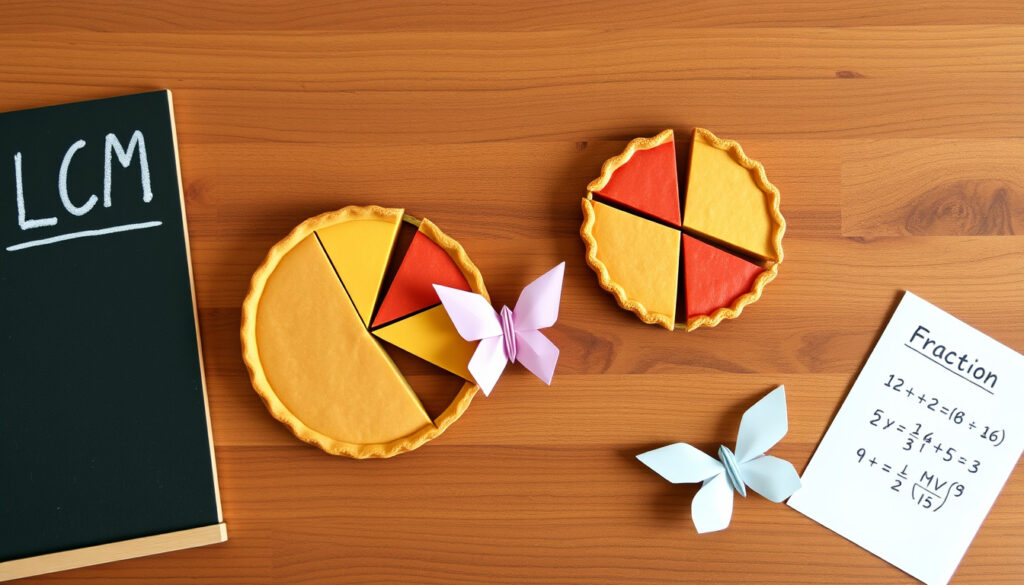
How to Add Fractions: LCM & Butterfly Methods Explained
If you’ve ever watched a student stare blankly at 1/3 + 1/2, you know the struggle with unlike denominators is real. The good news: adding fractions follows a clear set of rules, whether you’re working with same denominators or different ones.
Butterfly method steps: 4-step diagonal method (Geniebook) · Curriculum standard: Common Core 5.NF.A.1 (CCSS) · Educator warning: Skips LCD practice (Cognitive Cardio Math)
Quick snapshot
- Fractions with like denominators are added by adding numerators and keeping denominator (Geniebook).
- Fractions with unlike denominators require conversion to a common denominator (Common Core).
- Butterfly method outputs correct sum for two fractions with different denominators (Twinkl).
- Whether the butterfly method is faster than LCM for all pair types is debated in math education (Cognitive Cardio Math).
- Optimal order to teach adding fractions (LCM first vs butterfly first) varies by curriculum. (Cognitive Cardio Math)
- Some educators argue the butterfly method hinders conceptual understanding of common denominators (Cognitive Cardio Math).
- Butterfly method gained traction on YouTube and TikTok over the last decade (YouTube tutorial).
- Students should learn both methods and choose based on problem type and comfort with multiplication.
Five rules define how fractions are added, each with a different level of flexibility.
| Rule | Detail |
|---|---|
| Standard rule | Denominators must match before adding numerators (Geniebook). |
| LCM method | Works for all fraction pairs; taught in grades 4-5 (Common Core). |
| Butterfly method | No LCM needed; popular on social media; requires multiplication (Geniebook). |
| Common mistake | Adding numerators and denominators together (e.g., 1/2+1/3=2/5) (Move It Math The Source). |
| Simplification | Always reduce final fraction to lowest terms using GCD (Twinkl). |
How do you add fractions step by step?
Understanding the parts of a fraction
- The numerator (top number) counts the parts you have.
- The denominator (bottom number) tells the total parts in the whole (Geniebook).
- Example: In 3⁄4, 3 is the numerator and 4 is the denominator.
Mistaking which number belongs on top is the most common error—and it starts here. A firm grasp of numerator and denominator prevents the “add everything” reflex later.
When denominators are the same
- Rule: Add only the numerators; keep the denominator unchanged (Geniebook).
- Example: 1⁄5 + 2⁄5 = 3⁄5.
- If the sum is an improper fraction (numerator ≥ denominator), convert to a mixed number.
When denominators are different
- You cannot add 1⁄3 and 1⁄2 directly because the parts are different sizes.
- You must rewrite both fractions with a common denominator before adding (Common Core).
- Two main strategies: finding the least common multiple (LCM) or using the butterfly method.
The implication: building flexibility with both methods prepares students for a wider range of problems.
How to add 2 fractions with different denominators?
-
Step 1: Find the least common multiple (LCM)
The LCM is the smallest number both denominators divide evenly into (Twinkl). Example: For 1⁄3 and 1⁄2, the LCM of 3 and 2 is 6. List multiples: 3,6,9,… and 2,4,6,… — the smallest common is 6.
-
Step 2: Convert each fraction to an equivalent fraction
Multiply numerator and denominator by the same number to get the LCM as the new denominator (Geniebook). 1⁄3 becomes 2⁄6 (multiply top and bottom by 2). 1⁄2 becomes 3⁄6 (multiply by 3).
-
Step 3: Add the numerators and simplify
Add the converted numerators: 2⁄6 + 3⁄6 = 5⁄6. Simplify if needed. 5⁄6 is already in lowest terms. Always reduce by dividing numerator and denominator by their greatest common divisor (GCD) (Twinkl).
The LCM method builds a foundation for algebra. Students who skip it now may struggle with rational expressions later. The trade-off is speed: it takes more steps than the butterfly shortcut.
The pattern: the LCM method, while slower, develops number sense that pays off in higher math.
Is there a trick to adding fractions faster?
The butterfly method explained
- Write the two fractions side by side.
- Draw “wings” along the diagonals and multiply: multiply the numerator of the first by the denominator of the second, and the numerator of the second by the denominator of the first (Geniebook).
- Add those two products to get the new numerator.
- Multiply the two denominators to get the new denominator (Geniebook).
- Simplify the resulting fraction if possible (Twinkl).
Butterfly method example: 1/3 + 1/2
- Diagonal 1: 1 × 2 = 2
- Diagonal 2: 1 × 3 = 3
- New numerator: 2 + 3 = 5
- New denominator: 3 × 2 = 6
- Result: 5⁄6 — same answer as the LCM method.
When the butterfly method is fastest
- Works best with two fractions where the denominators are prime or have no common factors (YouTube tutorial).
- Not ideal for three or more fractions; the LCM method scales better (YouTube tutorial).
- Can produce large numerators that still require simplification.
Cognitive Cardio Math warns that relying solely on the butterfly method prevents students from practicing finding least common denominators—a skill needed for higher math (Cognitive Cardio Math). The trade-off is short-term speed vs. long-term fluency.
What this means: the butterfly method is a tool, not a replacement for understanding denominators.
How to add fractions with whole numbers?
Convert the whole number to a fraction
- Write the whole number over 1: e.g., 2 becomes 2⁄1.
- Now you have two fractions with different denominators (the whole number’s denominator is 1).
Add fractions with common denominator
- Find a common denominator between the fraction’s denominator and 1.
- Since any number divided by 1 is itself, the common denominator is usually the other fraction’s denominator.
- Example: 2 + 1⁄3 → 2⁄1 + 1⁄3 → 6⁄3 + 1⁄3 = 7⁄3 = 2⅓.
Worked example: 3/4 + 5
- Write 5 as 5⁄1.
- LCM of 4 and 1 is 4.
- Convert 5⁄1 to 20⁄4.
- Add: 3⁄4 + 20⁄4 = 23⁄4 = 5¾.
The implication: this method extends naturally from fraction addition, reinforcing the core concept.
How to add fractions with mixed numbers?
Method 1: Convert mixed numbers to improper fractions
- Multiply the whole number by the denominator, then add the numerator (Geniebook).
- Example: 1½ = (1×2+1)/2 = 3⁄2.
- Now add using the butterfly or LCM method.
Method 2: Add whole parts and fractional parts separately
- Only works if the fractional parts already share a common denominator.
- Add the whole numbers, then add the fractions separately.
- If the fraction sum is improper, carry over to the whole part.
Worked example: 1 1/2 + 2 2/3
- Convert: 1½ = 3⁄2, 2⅔ = 8⁄3.
- LCM of 2 and 3 is 6.
- 3⁄2 = 9⁄6, 8⁄3 = 16⁄6.
- Add: 9⁄6 + 16⁄6 = 25⁄6 = 4⅙.
Converting to improper fractions first is the most reliable route because it avoids the carry-over headache. The separate method saves time only when denominators already match.
The implication: students should default to the conversion method to reduce errors.
How to add fractions with same denominators?
The rule: add numerators only
- Keep the denominator exactly the same; never add them.
- Example: 1⁄5 + 2⁄5 = 3⁄5 (Geniebook).
Why the denominator stays the same
- The denominator tells you the size of each part. When all parts are the same size, you just count how many you have.
- Think of it like slices of the same pizza: 1 slice + 2 slices = 3 slices, not 3 slices of a different size.
Always simplify if numerator larger than denominator
- 7⁄5 becomes 1⅖.
- Divide numerator by denominator, write the remainder as a fraction.
What this means: same-denominator addition is the simplest case and the foundation for all other fraction addition.
How to add fractions with different denominators without LCM?
The butterfly method for fast addition
- As described earlier, this method bypasses finding the LCM by cross-multiplying diagonally (Geniebook).
- It works correctly for any pair of fractions.
Cross-multiplication approach
- New numerator: (a × d) + (c × b) / (b × d).
- Example: 3⁄4 + 2⁄5 → (3×5)+(2×4) over (4×5) = (15+8)/20 = 23⁄20.
- This is mathematically equivalent to the butterfly method.
When to use each method
- Use the LCM method when denominators are small and you want a simpler final fraction.
- Use the butterfly/cross-multiplication when denominators are prime or you want to avoid listing multiples.
- For three or more fractions, fall back to LCM (YouTube tutorial).
The butterfly method cuts steps but can produce numerators in the hundreds. For students comfortable with multiplication tables, it’s a time-saver. For others, the LCM method offers smaller numbers to work with.
The implication: matching the method to the problem context is more important than always using the same shortcut.
Adding fractions with unlike denominators is a foundational skill for algebra and beyond. Students who master both the LCM and butterfly methods have a toolkit that adapts to any problem.
Khan Academy educator
The step-by-step approach using fraction bars helps students visualize why common denominators are necessary before combining numerators.
BBC Bitesize math guide
Standard 5.NF.A.1: Add and subtract fractions with unlike denominators (including mixed numbers) by replacing given fractions with equivalent fractions.
Common Core State Standards
The choice between the LCM method and the butterfly shortcut isn’t about right vs. wrong—it’s about matching the tool to the student’s comfort with multiplication. For students in grades 4-5 who face Common Core 5.NF.A.1, the LCM method builds the conceptual foundation that pays off when rational expressions appear in middle school. For parents helping with homework on a tight schedule, the butterfly method offers a fast, correct route—as long as simplification isn’t forgotten. The implication: learn both, but lead with the LCM method in the classroom and save the butterfly for test review and real-world speed needs.
youtube.com, youtube.com, youtube.com, moveitmaththesource.com
For a more visual breakdown of this technique, check out our step-by-step guide which also covers the butterfly method in detail.
Frequently asked questions
What is the butterfly method for adding fractions?
The butterfly method is a shortcut for adding two fractions with different denominators. You cross-multiply the numerators diagonally, add the products, and multiply the denominators to get the new denominator (Geniebook).
How do you add fractions with whole numbers?
Write the whole number as a fraction over 1 (e.g., 2 = 2/1), then find a common denominator with the other fraction and add normally.
What is the least common multiple (LCM) in fractions?
The LCM is the smallest number that both denominators divide into evenly. It becomes the common denominator when adding fractions with unlike denominators (Twinkl).
Can you add fractions without finding the LCM?
Yes. The butterfly method and cross-multiplication both produce a common denominator without explicitly listing multiples, though the resulting denominator may be larger.
How do you simplify a fraction after adding?
Divide the numerator and denominator by their greatest common divisor (GCD). If the numerator is larger than the denominator, convert to a mixed number (Twinkl).
Why can’t you add numerators when denominators are different?
Because the denominators represent different-sized parts. You must convert them to a common size (same denominator) before combining.
How do you add three fractions with different denominators?
Find the LCM of all three denominators, convert each fraction to an equivalent fraction with that LCM, then add the numerators. The butterfly method works only for two fractions (YouTube tutorial).
More related posts
 Best Nail Salon Near Me in Dublin: Prices, Health Tips & Red Flags
 P Diddy Net Worth 2025: $400M–$900M After Billionaire Loss
 State Farm Home Insurance: Reputation, Cost & Complaints 2026
 Worms in Dog Poop: What to Do, Treatment & Prevention
 Best Ice Cream Near Me: Top Brands, Local & Diet Options
 Taylor Swift Concert Dates 2026-2027: No Shows Announced Yet
 Sofia the First Lyrics: Theme Song Full Text & Variations
 Dow Jones Industrial Average Compare: Live DJIA vs Indexes